


















Anxiety & Stress — Promotes Calm During Travel, Separation, or Noise.
The dog is already panting before the car leaves the driveway. At the rest stop, you wrestle with the leash while saliva streaks the door panel and the seatbelt cover carries fresh teeth marks. You bought a calming chew, gave it a chance, and still ended up managing a frightened dog instead of taking a normal trip.
That result usually isn't a failure of calming support. It's a diagnosis problem. Travel anxiety isn't one condition, and “anxiety & stress, promotes calm during travel, separation, or noise” only becomes useful when you identify what your dog is reacting to. A crate-averse dog needs confinement work. A nauseated dog needs motion-sickness management. A noise-sensitive dog needs sound control and conditioning. A dog panicking because you disappear needs a separation plan.
The most practical approach is a trigger triage followed by a focused countdown. Use the next 48 hours to identify the mechanism, remove obvious stressors, and run a small practice session. For lasting change, expect conditioning to take one to three weeks for many dogs, not a single dose on departure morning.
Table of Contents
- When Calm Plans Actually Work
- Four Anxiety Triggers and Why They Need Different Fixes
- Pre-Trip Prep and Conditioning That Pays Off on Day One
- Calming the Car, the Crate, and the Boarding Facility
- Training, Pheromones, and Calming Chews Compared
- Vet Checks and Safety Considerations Before Adding Supplements
- Your 7-Day Calm-Dog Countdown and When to Escalate
When Calm Plans Actually Work
A calm plan works when you put the interventions in the correct order. First identify the trigger. Then reduce exposure intensity. Then pair the manageable version of that trigger with food, rest, or another safe experience. A supplement can support that process, but it can't teach a dog that a crate, engine, or departure cue is safe.
Start with one observation session. Sit beside the parked car with your dog and note what happens:
- Door open, engine off: Does your dog approach, eat, and settle?
- Door closed, engine off: Does panting or scratching begin immediately?
- Engine running: Does the response change before the vehicle moves?
- Vehicle moving: Does drooling, vomiting, freezing, or frantic repositioning appear?
- Owner leaving: Does panic begin when you step away, even in a familiar place?
These distinctions matter because anxiety signs overlap. Panting, pacing, drooling, hiding, vocalizing, refusing food, and destructive chewing can all signal distress, but they don't identify the cause by themselves. Keep a short record of the trigger, the time to escalation, the behavior, and the recovery time.
Practical rule: A successful first trip doesn't require a perfectly relaxed dog. It requires a dog who can recover, take food, and remain physically safe.
Set three progress markers. The strongest early win is settling within ten minutes, eating during transit, or sleeping through ordinary engine noise. A partial win might mean less drooling, fewer attempts to escape, or a faster recovery at the destination. Don't judge progress only by whether your dog looked happy. Measure whether the reaction started later, stayed milder, or ended sooner.
Use the 48-hour plan to make the next exposure easier. Practice beside the car, then inside it, then with the engine on, and only afterward with movement. If the dog stops eating, escalates rapidly, or tries to injure itself, the session is too difficult. End it safely and reduce the next exposure rather than forcing a breakthrough.
Noise sensitivity deserves particular attention because it isn't rare. In a 2020 study of 13,700 Finnish pet dogs, 32% were highly fearful of at least one noise, making it the most prevalent anxiety trait measured in that study, according to the Scientific Reports study on canine behavioral traits. That finding supports a direct recommendation: don't treat every stressed traveler as a generic “nervous dog.”
Four Anxiety Triggers and Why They Need Different Fixes
The four buckets below are practical, not rigid diagnoses. A dog can have more than one trigger, but the first reaction usually tells you where to start.
Confinement anxiety
The dog becomes distressed when the crate door closes, even while the car is stationary. Scratching, biting bars, frantic turning, and vocalizing begin before motion or road noise enters the picture. The primary fix is gradual crate re-introduction, with meals and rewards delivered at a level where the dog can remain composed.
Motion sickness
Drooling, lip licking, nausea, vomiting, and a miserable posture can point to a vestibular problem rather than fear. The dog may be comfortable in a parked car and distressed only once the vehicle moves. The primary fix is a veterinary discussion about motion-sickness management, paired with short, controlled drives and appropriate feeding timing.
Engine and road noise
Some dogs react to the engine, tires, ventilation, or changing sound pressure rather than to travel itself. If distress starts when the engine turns on, use low-volume sound exposure, window coverage, stable airflow, and a quieter crate position. Sedation alone doesn't change the meaning of the sound or build tolerance.
True separation distress
This dog reacts to the person leaving, not merely to the car. The panic may occur at drop-off, boarding, or the moment the owner walks out of sight. Separation-related behavior problems have been estimated at about 20% of the dog population, and one veterinary review found dogs in single-adult households were about 2.5 times more likely to show separation anxiety, as summarized in this veterinary review of separation-related problems. The primary fix is alone-time training and, for severe cases, veterinary behavior support.
| Trigger | Primary Fix | Secondary Support |
|---|---|---|
| Confinement | Crate desensitization | Familiar bedding, food toys, covered crate |
| Motion | Veterinary motion-sickness plan | Empty-stomach travel, gradual drives |
| Engine or road noise | Sound desensitization | Window coverage, airflow, stable positioning |
| Separation | Graduated absences | Consistent handover, familiar scent, veterinary guidance |
Generic calming chews underperform when the mechanism is wrong. A chew may lower overall arousal, but it won't correct nausea, make a frightening crate predictable, or replace graduated separation exercises. Travel research also shows why triage matters. Owner-reported data found 14.6% of dogs experienced separation anxiety after air travel, while 3.8% had noise phobia, according to the AGRIS record on dog behavior and air travel. Those are different problems requiring different starting points.
Pre-Trip Prep and Conditioning That Pays Off on Day One
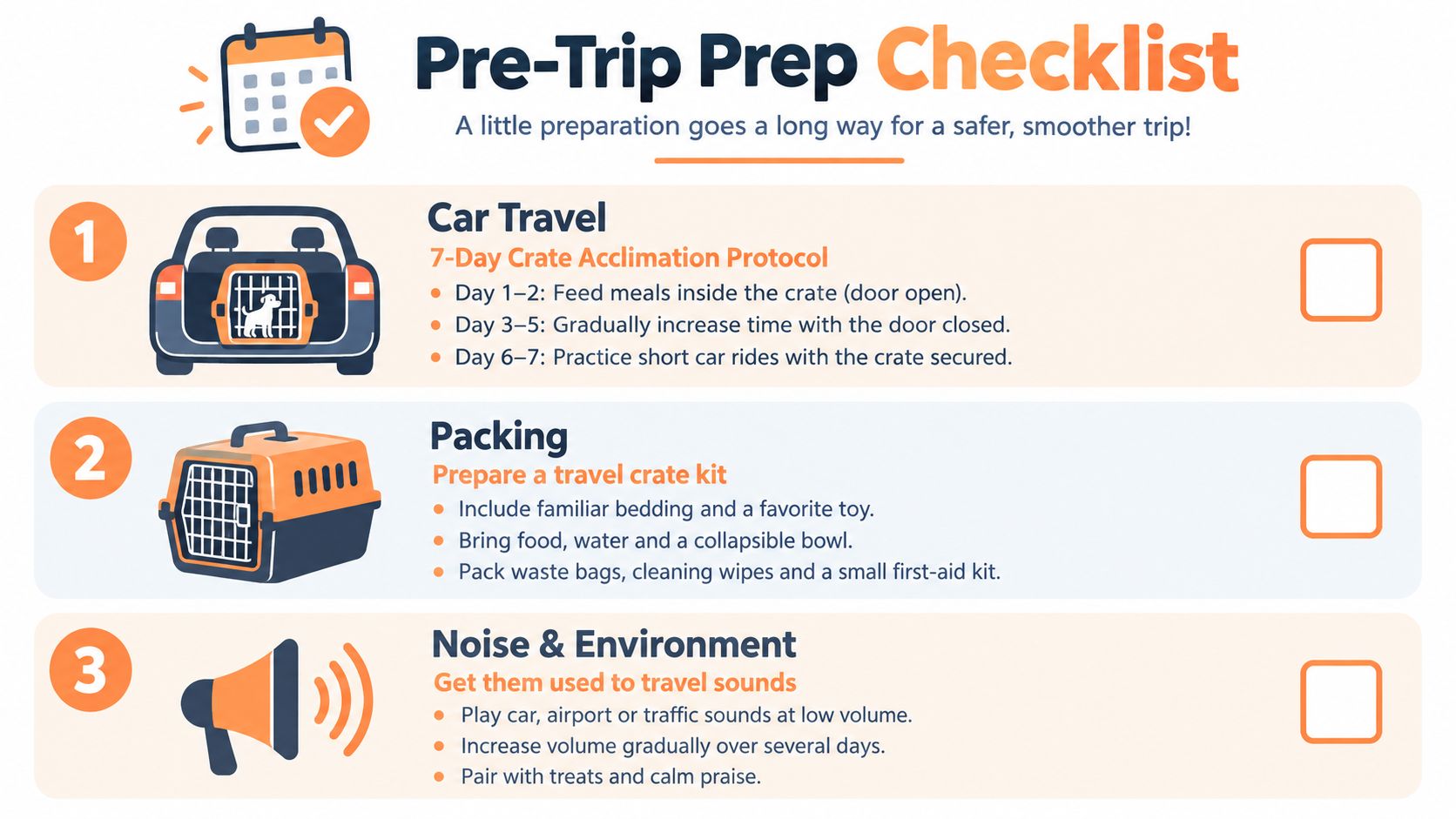
Start with the trigger that produces the earliest reaction. For a confinement-sensitive dog, run a seven-day crate re-introduction sequence. On the first days, feed meals inside the crate with the door open. Once the dog enters willingly, close the door for one minute, reopen it before distress appears, and gradually extend the duration across later sessions. Never use the crate as punishment, or you'll make the travel container predict isolation and conflict.
Motion-sensitive dogs need a different routine. Practice in a parked vehicle with the air conditioning running, then build drives from five minutes toward forty minutes only while the dog remains physically comfortable. Discuss meal timing and anti-nausea treatment with your veterinarian. If vomiting or heavy drooling appears, don't label it “bad behavior.” Treat it as a medical travel problem until assessed.
For noise-reactive dogs, play a recording of engine or road sounds at a very low volume during meals. Raise the volume only when the dog continues eating and shows relaxed body language. Covering windows can reduce visual stimulation and some high-frequency road hum, while steady airflow can prevent overheating and reduce the intensity of a closed-in environment.
Pack for the handoff, not just the drive
A reliable kit includes a fitted harness, a secured crash-tested crate, a non-slip mat, water, familiar bedding, food, cleanup supplies, and any prescribed medication. Write down feeding times, medication windows, known triggers, and emergency contacts. A helper shouldn't have to guess whether your dog is refusing food from stress, nausea, or an unfamiliar schedule.
For broader preparation around accommodation, routines, and logistics, use this practical guide to plan a stress free vacation. If you're still deciding whether your dog should travel or stay elsewhere, review planning to travel and not sure what to do with your dog before booking.
Calming the Car, the Crate, and the Boarding Facility
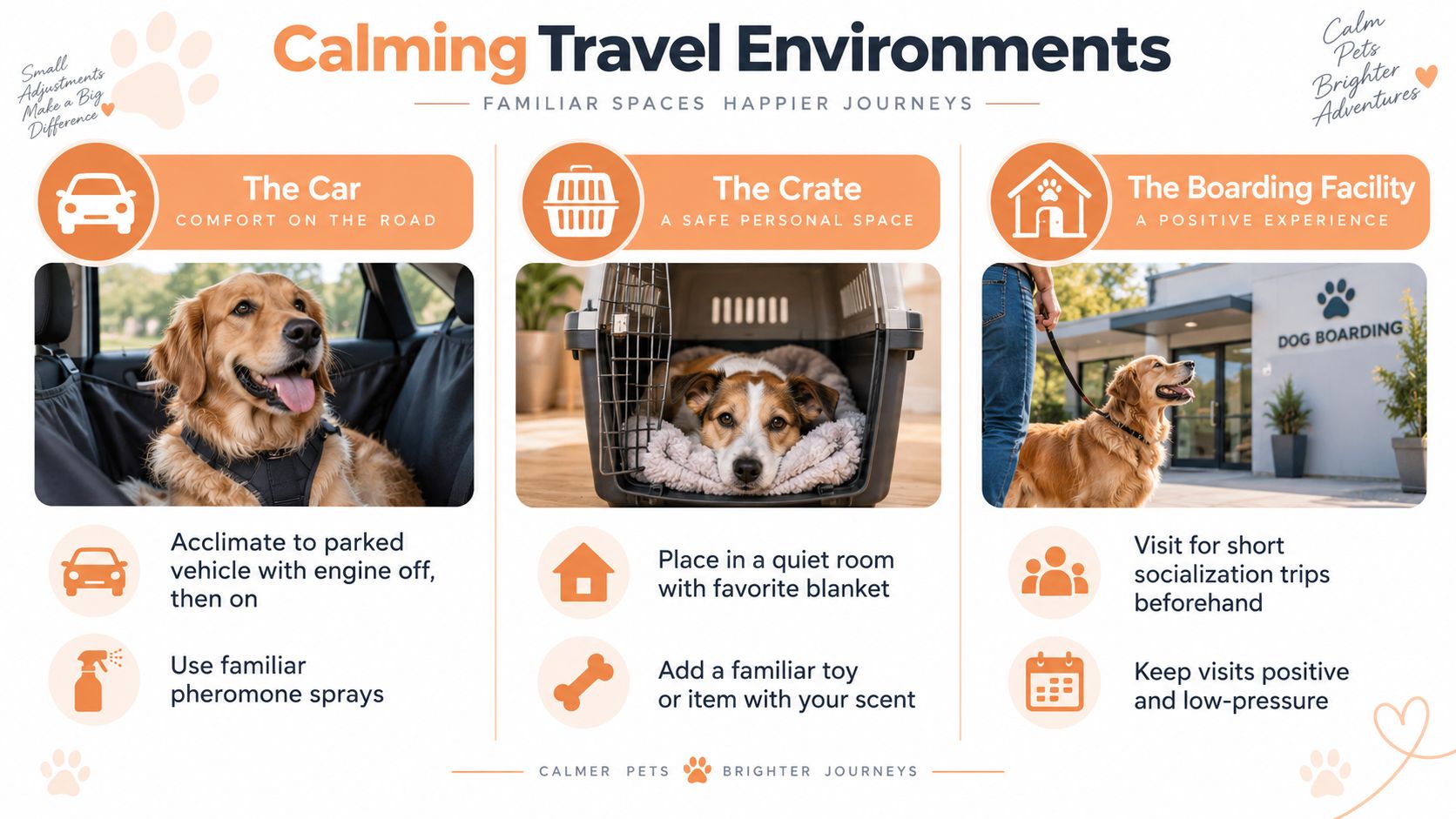
The car should become boring before it becomes mobile. Put the crate inside the parked vehicle with the engine off, reward calm entry, then repeat with the engine running. Position the secured crate where it won't slide, maintain cooling airflow, and avoid letting the dog roam between seats. For suspected motion sickness, discuss withholding food for two to three hours before the ride with your veterinarian, especially if your dog has a history of vomiting.
A crate should allow the dog to stand, turn around, and lie down without being compressed. A partially covered top can create a den-like visual barrier for dogs overwhelmed by passing scenery, but don't block ventilation. A frozen food-stuffed toy can give the dog a licking activity, provided the dog already uses that toy safely and doesn't guard it.
Don't force the door shut on a panicking dog. Repeated escape attempts teach the dog that confinement is dangerous and increase the chance of broken teeth, damaged nails, or self-injury.
Boarding introduces separation, unfamiliar people, scents, and routine changes. Tour the facility before the stay and ask how staff handle a dog that won't eat, vocalizes, or tries to escape. Bring a scent-soaked T-shirt from home, keep feeding times consistent, and provide a written handover sheet covering triggers, medication windows, feeding instructions, and emergency contacts.
For motion-related planning beyond car travel, these Nordmoose travel tips offer useful general principles about preparing for nausea and maintaining comfort during transit. They don't replace canine veterinary advice, but the preparation mindset is sound.
Training, Pheromones, and Calming Chews Compared
Behavioral training has the strongest long-term role. Desensitization keeps the trigger below the dog's panic threshold, while counterconditioning pairs the trigger with something valuable. That combination changes the dog's expectation. It takes owner consistency and often requires four to six weeks of structured work, so it isn't a departure-morning solution.
Pheromone products are more modest tools. A 2021 systematic review found no evidence that spray, diffuser, or collar delivery was superior, and rated the evidence differently by setting. The strongest support was moderate for reducing some thunderstorm fear behaviors, while evidence was weak for nonspecific stress in hospitalized dogs and mild for barking reduction and relaxation behaviors in shelter dogs, as reported in the systematic review of dog-appeasing pheromone studies. Use pheromones as environmental support, not as a substitute for trigger-specific training.
Calming chews sit between those options. They may help a mildly or moderately stressed dog stay below its escalation threshold during practice, but severe panic needs a veterinary plan. A 2025 randomized, blinded crossover trial in 54 dogs compared CBD alone with a combination containing CBD, L-tryptophan, and alpha-casozepine during car-travel stress. Only the combination significantly blunted the salivary cortisol response, with p=0.016, while CBD alone did not reach significance, according to the FDA animal health reference. Most secondary outcomes didn't change meaningfully, so a cortisol result shouldn't be presented as proof of broad behavioral efficacy.
| Intervention | Onset | Evidence Strength | Best-Fit Trigger | Main Limitation |
|---|---|---|---|---|
| Desensitization and counterconditioning | Gradual | Strongest long-term option | Noise, confinement, separation | Requires consistency and time |
| Pheromone analogs | Situational or gradual | Moderate to mild, depending on setting | Some noise or environmental stress | Effects vary and aren't reliably superior by format |
| Calming chews | Product-dependent | Mixed and formula-specific | Mild situational stress | Weak as a standalone answer for severe panic |
If you're comparing ingredients and formats, start with calming treats for anxious dogs, then ask whether the product matches the actual trigger. PetScy's Calming Aid Chews are one supplement option described for relaxation support during travel, separation, storms, and other situational stressors. Treat that support as a bridge to training and management, not a replacement for either.
Vet Checks and Safety Considerations Before Adding Supplements
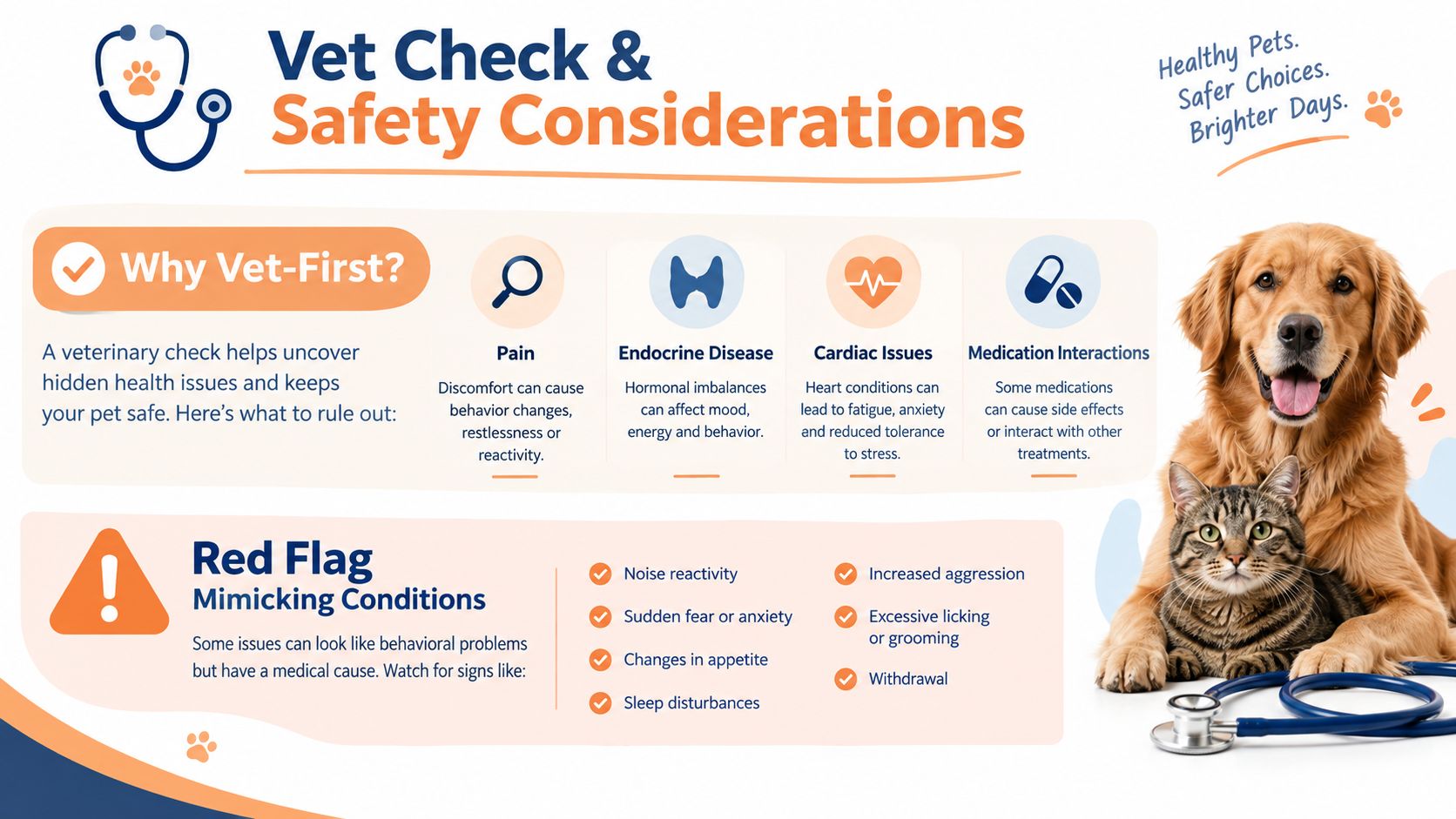
A sudden behavior change deserves a health check before a supplement trial. Pain, endocrine disease, heart problems, sensory decline, gastrointestinal illness, and medication effects can all look like anxiety. A dog that suddenly fears familiar sounds or pants heavily during mild activity may be communicating a medical problem, not asking for a stronger chew.
The vet-first sequence is straightforward:
- Physical examination: Look for pain, mobility limits, dental disease, respiratory problems, and cardiovascular signs.
- Diagnostic baseline: Discuss bloodwork when the history or age makes it appropriate.
- Medication audit: List every prescription, supplement, topical, and over-the-counter product.
- Seven-day behavior log: Record the trigger, intensity, appetite, stool, vomiting, sleep, and recovery.
- Product review: Check active ingredients, exact amounts, inactive ingredients, and manufacturer quality controls.
A calming chew is a tool, not a diagnosis. It can support a plan, but it shouldn't delay an examination when the behavior is new, severe, or worsening.
Read the label for transparent active doses rather than a proprietary blend with no quantities. Avoid products that contain ingredients unsafe for dogs, and don't assume “natural” means interaction-free. Start only after your veterinarian has reviewed the formula, begin at the low end of the labeled range, and change one variable at a time.
Track sedation, diarrhea, vomiting, appetite changes, and paradoxical excitement. If your dog becomes unusually dull, agitated, uncoordinated, or physically ill, stop the trial and contact the clinic. For prescription and non-prescription approaches, this overview of travel sedative options for dogs can help you prepare questions, but medication selection belongs with your veterinarian.
Your 7-Day Calm-Dog Countdown and When to Escalate
A countdown forces you to stop experimenting randomly. Assign each day one job, record the response, and don't increase difficulty if the dog can't remain under threshold.
Day 7 and Day 6
Day 7: Call your veterinarian and request health clearance, especially if anxiety is new, severe, or paired with vomiting, pain, coughing, exercise intolerance, or appetite change.
Day 6: Begin the baseline log. Record what happens when the dog sees the crate, enters the car, hears the engine, experiences movement, and watches you leave. If separation is the main issue, use the dog separation anxiety tips to structure very short absences without pushing the dog into panic.
Day 5 through Day 3
Day 5: Run a crate or carrier session indoors. Feed near the entrance, then inside with the door open. Progress to brief door closure only while the dog stays relaxed.
Day 4: Take the first short drive. Keep the route predictable and stop before the dog escalates. A dog that returns home calm has learned more than a dog forced through a long, frightening ride.
Day 3: Run a mock trip. Load the secured crate, use the planned mat and bedding, start the engine, drive, stop, unload, and repeat the arrival routine. Practice the handoff if another person will board or transport the dog.
Day 2 and Day 1
Day 2: If your veterinarian approves a calming supplement, trial the planned dose at home and observe appetite, stool, alertness, coordination, and excitement. Don't test a new product for the first time at the airport, boarding door, or on a long drive.
Day 1: Keep the routine ordinary. Feed according to the veterinary plan, load with the familiar harness or crate, maintain airflow, and offer the same arrival cues used during practice. At the destination, give the dog a quiet decompression period before introductions, exercise, or play.
Escalate to a veterinary behaviorist when home management isn't enough. Seek professional help for self-injury, broken teeth from biting crate bars, elimination during previously house-trained periods, new aggression, refusal to eat for more than 24 hours, or symptoms that intensify across two consecutive trial sessions. These signs indicate that the dog is no longer learning from exposure and may need medical treatment, specialized behavior modification, or both.
After the trip, write a debrief while details are fresh. Note the trigger, the intervention, the time to settle, food intake, nausea, sleep, and recovery at arrival. Your next travel cycle should start with those observations, not a guess about which product to buy.
PetScy offers veterinarian-formulated calming support alongside products for digestive, dental, skin, ear, joint, and immune care, so you can build a practical routine around your dog's broader needs. Visit PetScy to review the Calming Aid Chews and choose support that fits a trigger-specific travel and separation plan.