

















How to Help Your Dog Become Calm and Confident
You're halfway through dinner when the dog starts pacing. A car door shuts outside, the pacing becomes barking, and by the time the noise stops your dog is too wound up to settle. The same pattern may appear with visitors, car rides, separation, or another dog on the pavement. It's exhausting, but it isn't proof that your dog is difficult or disobedient.
A calm and confident dog isn't necessarily relaxed in every situation. More often, that dog has learned what to do when something feels threatening, and has enough emotional capacity to perform that skill. The practical route combines trigger-specific training, predictable routines, environmental management, enrichment, and, when appropriate, a carefully chosen calming aid.
Table of Contents
- Why Calm Confidence Is a Skill Dogs Learn
- Reading Stress Signals and Building Routine
- Training, Enrichment, and Management That Work Together
- Where Calming Supplements and Pheromones Fit
- Matching the Right Approach to the Trigger
- Tracking Progress and Knowing When to Seek Help
Why Calm Confidence Is a Skill Dogs Learn
A dog freezes when the mail carrier approaches, retreats behind your legs when a stranger enters, or snaps as another dog passes. Owners often describe these moments as stubbornness or bad attitude, but the behavior usually communicates that the dog's coping system is overloaded. The dog isn't choosing an effective response. It's reaching for the response that feels available.
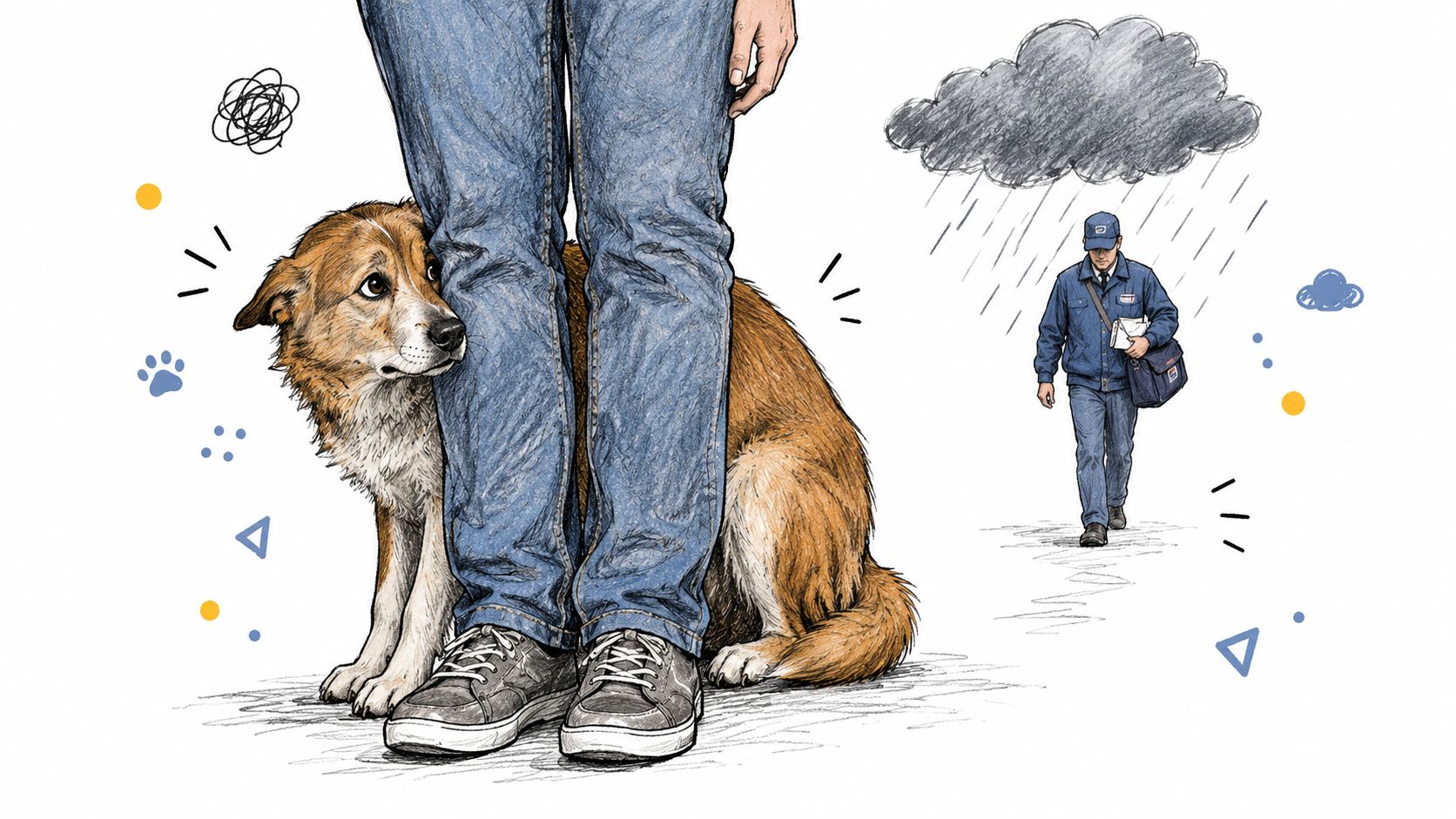
That distinction changes the work. Instead of demanding confidence during the hardest moment, you create manageable opportunities for the dog to notice a trigger, remain under threshold, and choose a different action. A glance at the mail carrier followed by turning back to you can become more useful than an intense greeting or a dramatic correction.
Research summaries connect self-regulation practices with self-efficacy, the belief that you can handle a situation, and describe confidence as something shaped by repeatable behavior rather than a fixed personality trait. The University of Utah Extension summary on tranquil moments and confidence links calming methods such as mindfulness with stronger self-esteem and self-efficacy. Dogs need a species-appropriate version of the same principle: repeated, successful regulation gives them evidence that they can cope.
What practice looks like at home
Start where your dog can still eat, sniff, respond to their name, or move away without panic. You might stand far from the front window while a helper walks past, reward a soft body and disengagement, then end the exercise before your dog escalates. On another day, you may practice settling on a mat after a quiet walk, when the nervous system is already more prepared to learn.
A short, repeatable exercise beats an occasional heroic attempt. Keep a record of the trigger, distance, body language, recovery, and what helped. Resources such as these confidence exercises for a happier dog can provide additional ideas, but adapt every exercise to the individual dog rather than copying a challenge that pushes them too fast.
Practical rule: Don't ask for bravery at the point of panic. Build competence at a level your dog can handle, then increase difficulty gradually.
The phrase Keep Calm and Carry On offers a useful cultural metaphor. The poster was created in 1939 as one of three British government morale posters during World War II, although it wasn't displayed during the war and remained obscure until its rediscovery in 2000, after which it became widely recognized. That history, described in the account of the poster's revival and confidence message, captures the idea of composure under pressure. For dogs, composure isn't a slogan. It's a behavior built through safe repetition.
Reading Stress Signals and Building Routine
Training fails when the dog is already beyond the point of learning. Your first job is to spot the early signs, before a quiet concern becomes barking, lunging, hiding, or snapping. Stress often appears in small changes that owners miss because they're waiting for an obvious reaction.
Watch for:
- Whale eye: The dog turns their head away while showing the white crescent of the eye.
- Lip licking: Repeated licking can signal discomfort, especially when no food is present.
- Sudden sniffing: A dog may drop their nose to the ground to avoid social pressure or delay an interaction.
- Body stiffness: Stillness, weight shifted forward, a closed mouth, or a fixed stare deserves attention.
- Retreat and displacement: Moving behind furniture, shaking off, scratching, or yawning can indicate that the situation is becoming difficult.
These signals don't have one universal meaning. Context matters. A yawn after waking isn't the same as repeated yawning while a visitor leans over the dog. Look for clusters, changes from your dog's normal behavior, and what happens immediately before and after the signal.
Build a rhythm your dog can predict
A predictable day reduces the number of surprises your dog must process. Set broadly consistent windows for meals, walks, play, rest, training, and quiet decompression. You don't need to run the household by a rigid clock, but your dog should recognize the sequence of ordinary events.
A useful daily rhythm might include:
- A quiet morning toilet walk with time to sniff.
- Food followed by rest rather than immediate excitement.
- A short training session when the dog is receptive.
- Enrichment during the part of the day when pacing usually begins.
- A decompression period after visitors, travel, or busy outings.
Departures and arrivals deserve the same care. Keep leaving cues ordinary, avoid turning reunions into a surge of excitement, and give your dog a calm activity after you return. If separation distress is severe, don't use long absences as practice. Start with a professional plan that keeps the dog below panic.
Routine won't remove every trigger, but it gives your dog more stable ground from which to learn. It also helps you notice patterns. If the pacing appears after poor sleep, a crowded walk, or an unpredictable evening, you can change the environment before the behavior peaks.
Training, Enrichment, and Management That Work Together
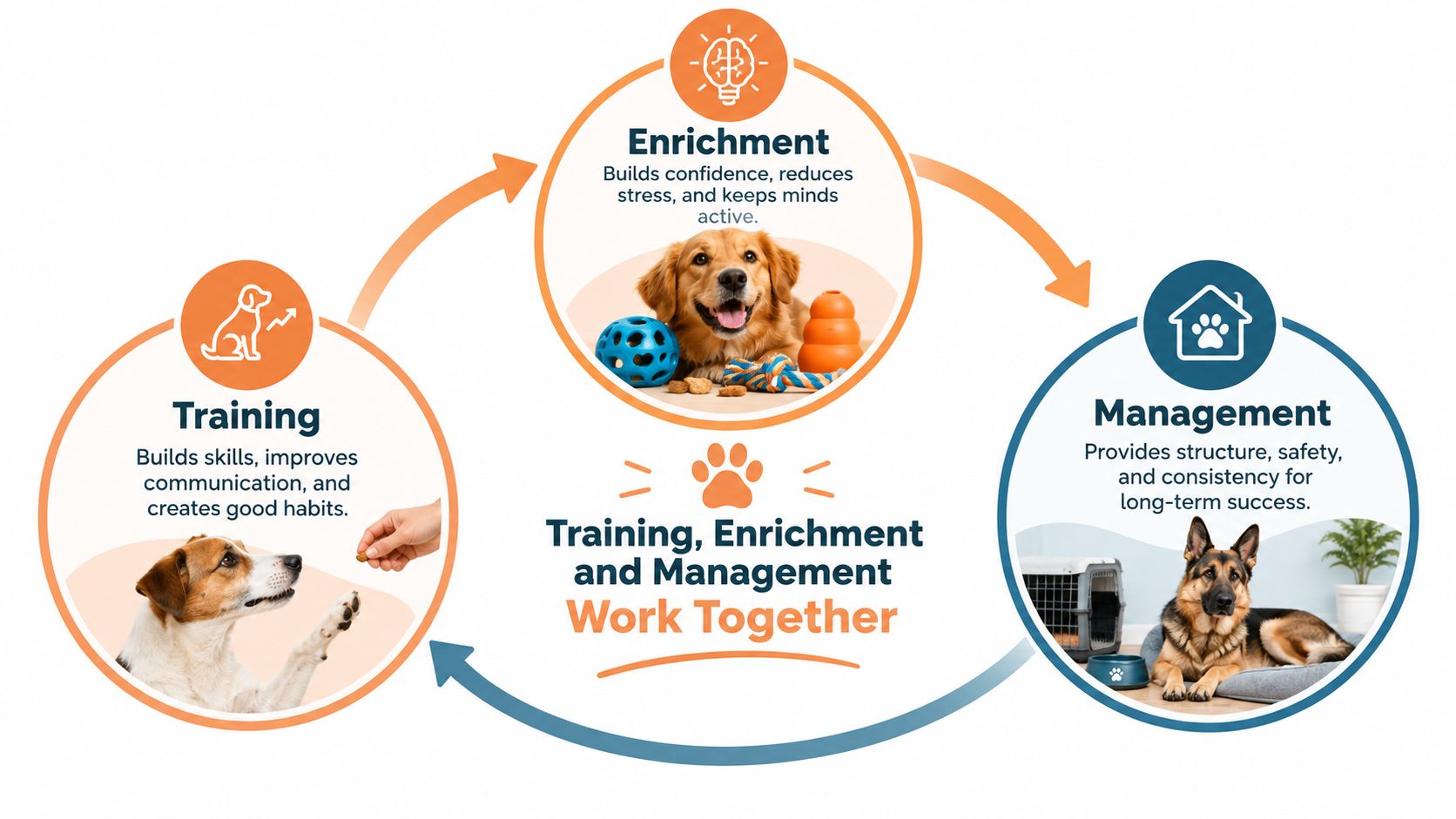
A behavior plan works best when each part solves a different problem. Training teaches an alternative, enrichment helps meet behavioral needs, and management prevents the dog from rehearsing the unwanted response. Remove one part and the remaining pieces carry more weight than they should.
Consider a dog who barks at pedestrians through the front window. Training might teach the dog to move to a mat and look toward the owner when a person passes. Enrichment could shift the dog's daily outlets toward sniffing games, food puzzles, and chewing. Management might involve closing the curtain during busy periods, moving furniture away from the window, and using a quieter route for walks.
Give the dog a replacement behavior
Pick an action that can compete with the trigger and is easy to reinforce. A nose target, hand touch, mat settle, or voluntary check-in can work when taught away from distractions first. Reward the dog for noticing the trigger and returning to the alternative, not only for staying silent.
After a walk, offer a chew in a quiet area, then reinforce brief periods of relaxed posture. This sequence matters. The chew supports decompression, while the settle exercise teaches the dog what to do with the lower arousal that follows.
Management should be practical rather than punitive. If a fence, gate, or visual barrier can prevent repeated charging along a boundary, research 2026 dog fence choices in CT before choosing an arrangement. The right physical setup can create enough distance for training to occur without constant rehearsal of fence running or barking.
Design enrichment around the dog
Enrichment isn't just a way to tire a dog out. It should meet the dog's preferred behavioral needs without creating more arousal. Scatter feeding supports nose work, shredding activities suit dogs who enjoy manipulating materials, and calm chewing can help create a predictable rest transition.
Rotate options instead of presenting everything at once. Observe whether the activity leaves your dog softer and more settled or faster, louder, and more frantic. The best choice is the one that improves recovery, not necessarily the one that produces the most visible activity.
For a practical companion to this integrated approach, see how to calm an anxious dog. The central principle remains simple: train the replacement, enrich the underlying needs, and manage the setting until the new skill becomes reliable.
Where Calming Supplements and Pheromones Fit
Calming products can be useful, but they're often given a job they can't perform. A chew, spray, diffuser, or collar may lower arousal during a difficult window. It can't teach a dog that the mail carrier is safe, make a separation plan unnecessary, or resolve a bite-risk behavior by itself.
A randomized controlled trial of an anxiety-focused canine nutraceutical reported improved behavior without adverse hematologic or biochemical effects, with several anxious-behavior measures improving during the treatment period. The practical lesson is methodological as much as clinical: use a consistent daily dose as directed and score behavior across repeated sessions, rather than deciding effectiveness from one impressive or disappointing day. The published canine nutraceutical trial also supports measuring behaviors such as pacing, jumping, or vocalization instead of using a broad claim that a product “cures anxiety.”
Use products as tactical support
A calming chew may fit a dog who becomes moderately unsettled before predictable travel, visitors, or a training session. Give it enough lead time according to the label and your veterinarian's advice, then pair the lower-arousal window with a planned behavior exercise. If no useful change appears after consistent, properly observed use, stop escalating the shopping list and reassess the plan.
Pheromone products require similarly careful expectations. A systematic review found no spray, diffuser, or collar formulation was superior overall, with moderate evidence for some fear and anxiety signs during thunderstorm noise, weak evidence for nonspecific hospital stress, and mild evidence for lower barking intensity and greater relaxation in shelter dogs. The systematic review of dog appeasing pheromones found that most changes occurred while the product was actively used, with minimal residual effect afterward.
That means timing matters. A diffuser or spray makes more sense as continuous support during the stress window than as an occasional product used after the dog is already overwhelmed. The evidence is also weaker for dogs older than six months, so frame pheromones as situational assistance, not a route to lasting anxiety resolution.
PetScy's Calming Aid Chews are one veterinarian-formulated supplement option described for relaxation, balanced behavior, and stress support. If you're comparing products, review ingredients, dosing instructions, contraindications, and the specific trigger you're addressing. The guide to calming treats for anxious dogs can help you think through that choice, but your veterinarian should review supplementation when your dog takes medication, has a medical condition, or shows severe distress.
A product earns its place when it helps the dog participate in the behavior plan. If it only makes the owner feel prepared, it isn't doing enough.
Matching the Right Approach to the Trigger
Different triggers produce different learning problems. A dog who panics at thunder needs a different plan from a dog who struggles when left alone, even if both dogs pace and vocalize. Match the intervention to what happens before, during, and after the behavior.
| Trigger | Primary focus | Where a calming aid may fit | Common mistake |
|---|---|---|---|
| Thunderstorms and sudden noise | Safe-room setup, sound masking, gradual sound work, and early intervention | Use before predictable noise when appropriate, with continuous environmental support | Waiting until panic has already begun |
| Separation | Graduated absence work, departure-cue practice, and careful duration increases | Consider only as support within a separation plan | Leaving the dog alone longer to “get used to it” |
| Car travel | Secure positioning, short low-pressure trips, predictable loading, and gradual exposure | Time a product before travel if your veterinarian approves | Treating nausea, fear, and motion sensitivity as the same problem |
| Strangers | Distance, choice, consent-based greetings, and reinforcement for disengagement | Support moderate arousal, but don't use it to force interaction | Holding the dog in place for petting |
Evidence varies by ingredient and situation, and many calming products lack strong data on quality, safety, or efficacy. A controlled 2025 study found only a mild stress-reducing effect from a CBD, L-tryptophan, and alpha-casozepine treat during car travel, not a broad cure for anxiety, as summarized by PetMD's review of dog calming products. That distinction matters. A result for travel shouldn't become a promise for separation, noise fear, or social reactivity.
Match the learning process, not just the label
For noise, predictability and environmental control usually come first. Close curtains, provide a secure retreat, use sound masking, and reinforce calm behavior before the noise reaches full intensity. For separation, avoid relying on a product to suppress distress. The dog needs carefully graduated absences that stay within their coping ability.
Car travel benefits from short, successful repetitions. Start with the parked car if necessary, then progress to brief movement and quiet destinations. A calming aid may help lower the starting arousal, but motion sickness or pain requires veterinary assessment rather than more supplements.
Stranger intolerance requires choice. Increase distance, allow the dog to retreat, and reward looking at the person before turning away. Never use sedation or a calming product as permission for a stranger to crowd the dog.
A useful travel, separation, and noise support guide can help you organize options, but the trigger remains the deciding factor. Don't stack every available tool. Select the smallest combination that makes learning possible, then evaluate the dog's behavior rather than the product's marketing language.
Tracking Progress and Knowing When to Seek Help
Vague impressions make behavior plans hard to adjust. Track each relevant session with a simple score for trigger intensity, distance, visible stress, response to food or cues, and recovery after the trigger passes. Use the same categories repeatedly so you can compare ordinary sessions, not just the worst day.
A useful record might include:
- Trigger and context: What happened, where, and at what time?
- Early signals: Did your dog lick their lips, stiffen, retreat, or sniff suddenly?
- Response: Could they eat, move away, orient to you, or perform a known behavior?
- Recovery: How long did it take to return to ordinary activity?
- Plan change: What will you make easier or more predictable next time?
The purpose isn't to create perfect data. It's to detect whether your dog is recovering more smoothly, accepting distance, and using the replacement behavior with less help. Don't measure only during disasters. Include calm practice sessions, because those show whether the skill is becoming part of daily life.
Bring in a qualified trainer or certified behavior consultant when you can't keep the dog below threshold, when progress repeatedly stalls, or when the plan is difficult to implement safely. Seek veterinary support for sudden behavior changes, suspected pain, medication questions, severe panic, or any situation involving a bite risk. A veterinary behaviorist may be necessary when anxiety is intense enough that learning cannot begin.
The broader need is substantial. A university report found that more than 84% of dogs showed at least mild fear or anxiety in everyday situations (Texas A&M's report on canine fear and anxiety). That doesn't mean every dog needs a supplement or specialist, but it does mean owners shouldn't wait for a crisis before asking for help.
PetScy offers veterinarian-formulated products, including Calming Aid Chews, for dogs needing support with relaxation during stress, alongside the training and trigger management described here. Visit PetScy to review the calming option and build it into a measured plan rather than treating it as a standalone fix.