















Calming Aid Chews — Ingredients for Relaxation & Stress Relief.
You reach for your keys, and your dog starts pacing. The work bag comes out, and the panting begins. By the time you touch the doorknob, your dog may be following you from room to room, whining, drooling, or watching the exit as if something terrible is about to happen.
That reaction isn't stubbornness or bad manners. Your dog may have learned that small departure cues predict your absence, so the body's internal alarm switches on early. Calming aid chews can support relaxation, but the right ingredient depends on the trigger, the dog, and the strength of the available canine evidence. This guide helps you identify the stress pattern, compare ingredients by evidence rather than popularity, read a label, and combine a chew with behavior work safely.
Table of Contents
- Why Your Dog Panics When You Grab Your Keys
- What Separation and Situational Stress Actually Look Like in Dogs
- The Calming Chew Ingredient Lineup Ranked by Canine Evidence
- How to Read a Calming Chew Label Like a Checklist
- A Step-by-Step At-Home Plan That Pairs Chews With Behavior Work
- Where Calming Chews Fit Alongside Behavior Therapy and Medication
- Safety, Drug Interactions, and Dogs Who Should Not Start Without a Vet
- When to Try a Chew at Home and When to Call Your Veterinarian
Why Your Dog Panics When You Grab Your Keys
Dogs learn patterns quickly. Keys jingling, a coat being lifted, a laptop going into a bag, or a particular sequence of footsteps can become warning signals. Your dog may not understand that you'll return later, but they can recognize that these cues often come before the door closes and the house becomes quiet.
A useful analogy is a smoke alarm that's become too sensitive. It may react to burnt toast as well as a real fire. In the same way, an anxious dog can respond to the preparation for departure before you've left. The pacing is the alarm, not the cause of the problem.
This distinction changes how you respond. Scolding a dog for following you, destroying a door, or vocalizing may add fear to an already difficult moment. A calmer approach identifies the exact cue, lowers the emotional intensity around it, and rewards the behavior you want to see.
Practical rule: Treat the keys as information. They tell you when your dog's stress response starts, which may be well before the separation itself.
A chew may help lower the volume of that alarm, particularly when the stress is predictable and mild. It can't teach a dog that departures are safe, and it shouldn't replace an assessment when distress is intense or persistent. The useful question isn't “Which calming chew is most popular?” It's “Which ingredient has the most relevant evidence for this dog's trigger, and how will I pair it with a practical plan?”
The sections ahead follow that order. First, identify whether the pattern involves separation or a specific event. Then compare ingredients, examine the label, build a behavior routine, and decide when home support is reasonable and when veterinary help should come first.
What Separation and Situational Stress Actually Look Like in Dogs
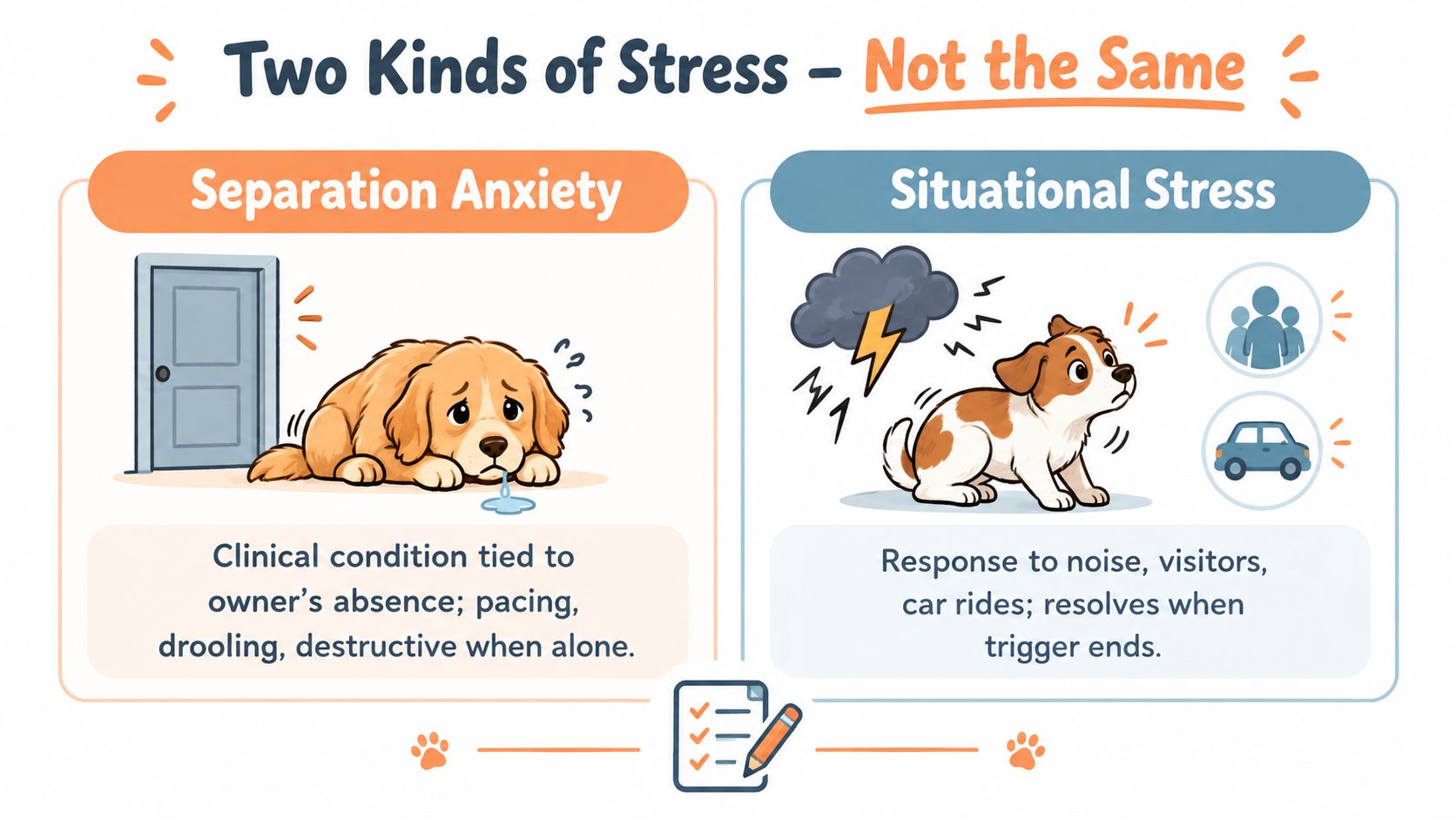
Separation anxiety is tied specifically to a person's absence. A dog with this pattern may become distressed when left alone, repeatedly pace near exits, drool, vocalize, chew doors, attempt to escape, eliminate indoors, or show intense greeting behavior when the owner returns. The response tends to recur around similar absences rather than appearing only during a particular sound or location.
Situational stress has a different shape. The trigger might be thunder, fireworks, a car ride, a veterinary visit, unfamiliar people, or a new environment. The dog may recover when the event ends or when they reach a safe, familiar place. A dog can experience both patterns, but the distinction matters because an ingredient or routine that suits a short event may not address daily distress when alone.
Read the behavior, not just the noise
Panting after exercise isn't automatically anxiety. Whining at a strange sound may be normal vigilance. Look at frequency, intensity, and persistence:
- Occasional unease: Your dog notices a sound, pauses, and returns to normal behavior.
- Repeated stress: Your dog pants, paces, trembles, hides, or clings during similar events.
- Severe distress: Your dog tries to break through doors, injures themselves, loses housetraining, can't settle, or remains distressed long after the trigger.
Drooling, trembling, escape attempts, destructive chewing near doors, and indoor elimination deserve attention, especially when they happen predictably during absence or exposure to a particular trigger. The same is true when a dog stops eating, can't sleep, or becomes unsafe around people or household objects.
Mild, predictable stress may be suitable for a carefully monitored home plan. Severe or worsening behavior calls for a veterinary assessment, because pain, illness, sensory changes, and established anxiety disorders can look similar to owners. A chew can be part of support, but it shouldn't delay help when your dog is at risk.
The Calming Chew Ingredient Lineup Ranked by Canine Evidence
A dog that trembles in the car, paces during fireworks, or shadows you before an absence needs a matched response, not the most popular chew. Popularity is a poor evidence ranking. L-theanine and L-tryptophan have more canine-specific support than many familiar botanicals, while several widely marketed ingredients remain limited or inconsistent in dog studies. This review of canine calming chew ingredients explains common product terms, but each active still deserves separate scrutiny.
A 2026 evidence review found only three clinical studies in dogs, all non-randomized, with small sample sizes, and two were judged at high risk of bias (review of anxiety and behavior supplements). Promising findings are useful clues, not proof that every blend will work for every dog. Product claims about rapid or broad relaxation also need careful checking against timing and safety for stress supplements.
| Ingredient | Evidence strength in dogs | Best matched trigger |
|---|---|---|
| L-theanine | Strongest single-ingredient support in the available canine supplement literature, though the evidence base remains limited | Daily nervousness, mild separation stress, travel, storms |
| Alpha-casozepine | Among the better-supported actives in canine calming research | General nervousness and ongoing mild stress |
| L-tryptophan | Canine-specific support is stronger than for many botanicals, but results still require cautious interpretation | General arousal and nervous behavior |
| Melatonin | More useful for sleep-linked timing or sedation than broad anxiety relief | Nighttime disruption and some predictable noise events |
| Chamomile | Commonly used, but dog-specific trial evidence is limited or mixed | Mild relaxation support when included in a broader formula |
| Valerian | Familiar in calming blends, with limited canine evidence | May be included for situational relaxation, but isn't a strong evidence-led first choice |
| GABA | Plausible calming rationale, but canine behavioral evidence is limited | General calming claims should be treated cautiously |
| Hemp-derived CBD | Under-researched in dogs, with unsettled dosing and inconsistent support for anxiety | Not a first choice when evidence specificity matters |
| Ashwagandha | Emerging interest, but limited dog-specific evidence for calming behavior | Avoid assuming human evidence transfers to dogs |
L-theanine is different from a direct sedative. Proposed mechanisms involve modulation of GABA, serotonin, and dopamine signaling, so the goal is reduced reactivity rather than making a dog sleepy. According to this veterinary summary of calming supplements, onset is roughly 30 to 60 minutes. That timing makes it a reasonable candidate to discuss for travel, storms, or a predictable separation event.
A 2023 review described one controlled context using 50 mg per day for dogs under 10 kg, 100 mg per day for dogs from 10 to 25 kg, and 200 mg per day for dogs over 25 kg, alongside reductions in anxiety scores and behaviors such as drooling, pacing, panting, following people, and hiding (canine L-theanine evidence review). Those figures belong to that research context. They are not a universal prescription or a reason to combine several products.
Match the active to the trigger. L-theanine and alpha-casozepine fit mild, recurring nervousness. L-tryptophan may suit general arousal, while melatonin makes more sense when sleep timing or sedation is the actual concern. Chamomile, valerian, GABA, CBD, and ashwagandha should not outrank better-supported choices because they appear in a longer blend.
How to Read a Calming Chew Label Like a Checklist
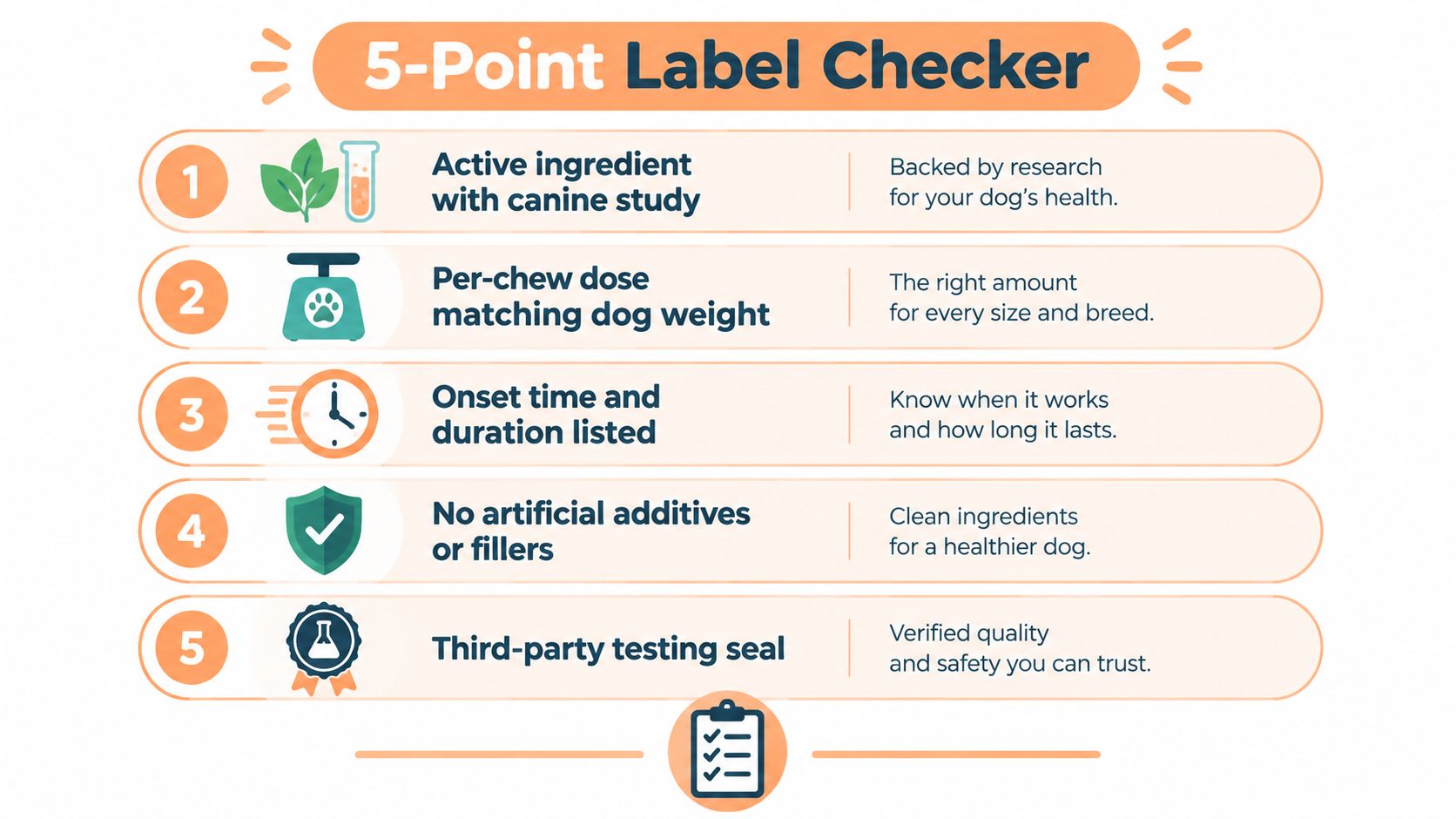
A dog may need help for fireworks, travel, separation, or everyday nervousness, but the label cannot choose the right ingredient for you. Start with five questions. If a chew promises “complete relaxation” or “advanced calming support” without naming active amounts, you cannot compare it meaningfully with canine research.
Start with the active ingredient
Find the exact amount of each active ingredient per chew. “Calming blend” is not a dose, and a long list does not show which ingredient is expected to help. Give greater weight to ingredients with dog-specific evidence, then check whether the product uses the same form studied and provides a comparable amount.
Read the serving directions alongside your dog's body weight. Compare the amount in one chew, and the number of chews recommended, with the previously discussed research range. If the label provides only a combined blend amount, you cannot tell whether any individual active reaches a studied level. That uncertainty is a reason to ask your veterinarian, not to add extra chews.
The trigger matters too. A product built around L-theanine may be more relevant to mild situational or recurring nervousness than to a dog whose main problem is disrupted sleep. Match the ingredient to the problem before comparing brands.
Audit the rest of the label
Use this sequence before buying or giving a product:
- Active amount: Confirm the amount per chew, rather than only the amount per serving.
- Dog suitability: Check whether it is intended for dogs of your dog's age and size.
- Inactive ingredients: Look for allergens such as chicken or dairy, and avoid xylitol, which is unsafe for dogs.
- Quality controls: Look for a National Animal Supplement Council mark, good manufacturing practice information, or a certificate of analysis. These signs improve manufacturing transparency, but they do not show that the chew will resolve anxiety.
- Timing and shelf life: Check the expiration date and whether the product is intended for daily use or situational dosing.
Treat melatonin claims carefully when a product presents it as a general anxiety solution. Canine research often examines sedation, sleep, or pre-anesthetic effects rather than broad emotional relief. “Natural” also describes the source, not the risk profile. An ingredient may affect alertness, digestion, seizure risk, or another medicine's action. This overview of natural anxiety remedies offers broader context, while your dog's medical history should guide the final choice.
A Step-by-Step At-Home Plan That Pairs Chews With Behavior Work
Consider a dog named Milo who starts pacing when his owner picks up the keys. The goal isn't to make Milo sleepy. The goal is to lower the emotional reaction enough that he can learn a new association: keys predict calm activity, not abandonment.
Find the first cue
For several days, observe the sequence without changing it. Does Milo react to the keys, the coat, the door, or the owner's disappearance? Write down the first sign, such as head lifting, lip licking, following, or panting. This gives you a starting point below the level where he loses the ability to learn.
A veterinary behavior consultation should come early when the reaction is intense, frequent, or worsening. Supplements tend to work best as support for a behavior plan, not as a substitute for diagnosis or training. The guidance in how to calm an anxious dog can help owners organize the home environment while they decide what professional support is needed.
Make the cue boring
Pick up the keys, pause, and sit down. Don't leave. When Milo remains relaxed, offer a reward or begin a favorite calm activity. Repeat at an intensity he can handle, then gradually add another departure cue. If he starts pacing or panting, the step was too difficult, so reduce it rather than pushing through.
If a veterinarian approves a chew, give it according to the label and professional guidance before a planned practice session. L-theanine is commonly associated with onset in roughly 30 to 60 minutes in independent veterinary summaries (timing summary for canine calming supplements), but response varies. Use the chew to support a learning window, not to force a distressed dog through a long absence.
Build absences gradually
Once Milo can tolerate the preparation cues, practice very short departures. Return before he becomes distressed, then vary the routine so he doesn't learn that every absence lasts the same length. Keep the room safe, use enrichment he already enjoys, and record the cue, chew, timing, absence, and observed behavior.
A simple log prevents wishful thinking. It also shows whether the chew changes the first signs of stress, the length of time Milo can remain settled, or only his outward activity level. Chews are scaffolding. The behavior plan is the structure.
Where Calming Chews Fit Alongside Behavior Therapy and Medication
A calming chew works best as one part of a broader plan. Environmental management and behavior modification provide the foundation: predictable routines, suitable exercise, enrichment, safe resting places, and gradual desensitization reduce opportunities for a dog to rehearse panic. A supplement may support that process when stress is mild and the trigger is predictable, but it cannot replace learning.
The match between ingredient and trigger matters. A chew might help create a calmer learning window before travel, fireworks, grooming, or another short event. It is less likely to solve separation anxiety by itself, because separation distress involves a repeated fear pattern that changes through carefully paced practice. For practical guidance on trigger-specific support, see our guide to managing anxiety and stress during travel, separation, or noise.
Pheromone diffusers and compression garments are other non-prescription options owners can discuss with a veterinarian. Prescription medication belongs in a separate category. A veterinarian may consider fluoxetine, clomipramine, or a situational benzodiazepine when anxiety is severe, persistent, or dangerous. The choice depends on the diagnosis, other health conditions, and when the trigger occurs.
| Tool | Evidence strength | Speed of effect | Best use case | Key limitation |
|---|---|---|---|---|
| Calming chews | Ingredient-dependent and limited overall | Some ingredients are used before predictable events; onset varies | Mild travel, noise, grooming, or early training support | Blends may hide dose and evidence differences |
| Behavior therapy | Central to changing fear and separation patterns | Builds through repeated practice | Separation anxiety and learned trigger responses | Requires consistency and careful progression |
| Prescription medication | Veterinary-selected according to diagnosis | Some are for ongoing support, others for specific events | Moderate or severe distress, safety concerns | Requires examination, monitoring, and interaction review |
| Pheromones | Variable support depending on product and situation | Intended for environmental use rather than immediate rescue | Home, travel, or predictable environmental stress | May not be sufficient for established anxiety |
| Environmental changes | Foundational support rather than a single treatment | Begins as soon as the environment changes | Noise reduction, routine, safe retreat, enrichment | Can't address every underlying fear by itself |
A structured resource such as PawCraft 30-day dog training can help owners practise consistently, while severe cases still require veterinary guidance. PetScy's Calming Aid Chews are one example of a multi-ingredient calming product. Read the full label and discuss suitability with a veterinarian, rather than assuming a longer ingredient list means stronger support.
The boundary is practical. A chew may support early training or a mild, predictable event. It is not a stand-alone answer when a dog cannot eat, sleep, stay safe, or tolerate routine absences.
Safety, Drug Interactions, and Dogs Who Should Not Start Without a Vet
A calming chew can become risky when its effects overlap with a medication. For example, combining L-tryptophan with an MAO inhibitor or SSRI may influence serotonin, while melatonin or valerian can add to sedation from another drug. “Natural” describes an ingredient's origin, not how it behaves in a dog's body. Each active ingredient needs to be reviewed in context.
Some dogs should receive veterinary clearance before starting any calming chew:
- Puppies under six months: Their nervous systems and medication needs are still developing.
- Senior dogs: Reduced liver or kidney clearance may change their response.
- Pregnant or lactating dogs: Safety information may be absent or insufficient.
- Dogs with epilepsy: Some ingredients may affect seizure risk or interact with anticonvulsant treatment.
- Dogs with liver or kidney disease: Clearance and tolerance may be altered.
- Dogs already taking medication: The veterinarian needs the complete ingredient list, not only the product name.
| Dog or medication profile | Ingredients requiring vet clearance | Why it matters |
|---|---|---|
| Puppy or senior dog | Any multi-ingredient calming chew | Age can affect sensitivity, metabolism, and response |
| Pregnant or nursing dog | Botanicals, melatonin, amino acids, and blends | Safety information may not cover reproduction or nursing |
| Epilepsy or seizure treatment | Valerian, chamomile, CBD, melatonin, and other actives | Nervous-system effects and interactions need individual review |
| Liver or kidney disease | Any product with multiple active ingredients | The body may process ingredients differently |
| MAO inhibitor or SSRI use | L-tryptophan | Agents that influence serotonin require veterinary oversight |
| Sedative or anesthetic use | Melatonin and valerian | Combined sedation can become excessive |
| Blood thinner use | Chamomile | Potential effects on clotting require professional review |
A long ingredient list makes this review harder, not safer. PetScy's Calming Aid Chews are one example of a multi-ingredient calming product, so keep the full label available and ask your veterinarian to assess every active and inactive ingredient.
Do not add a new chew to a prescription behavior drug without informing your veterinarian. Ask whether it should be stopped before anesthesia, and follow the clinic's instructions rather than applying a general rule. Stop the product and seek veterinary advice if your dog develops vomiting, sudden lethargy, changes in gait, or a new skin reaction.
When to Try a Chew at Home and When to Call Your Veterinarian
A home trial can be reasonable when the problem is mild, predictable, and limited to an event such as travel, a short grooming visit, or a known fireworks period. Start with a product whose active ingredient and amount are clearly listed, use the dog's weight when following directions, and avoid introducing several new supplements at once.
Track behavior before deciding whether it helped. Record the trigger, the signs you saw, the product and amount, when it was given, and how long the behavior lasted. A 7-to-14-day trial is the framework described in the plan for comparing a baseline with a response, but it isn't a universal treatment duration or a reason to continue if your dog worsens.
Choose veterinary care first when
Call your veterinarian before trying a chew if your dog has sudden behavior changes, self-injury, destructive escape attempts, loss of housetraining when alone, escalating fear, suspected pain, vomiting, refusal to eat, or a known medical condition. A consultation is also the right starting point for a puppy, senior, pregnant or nursing dog, a dog with epilepsy or liver or kidney disease, or a dog taking medication.
Tonight's checklist is simple:
- Log the baseline: Write down the trigger and your dog's first stress sign.
- Photograph the label: Keep the full active and inactive ingredient panel available.
- Weigh your dog: Use current body weight when reviewing directions.
- Choose one change: Don't introduce several calming products together.
- Book help for red flags: Contact your veterinarian if distress is intense, new, worsening, or medically complicated.
PetScy offers veterinarian-formulated supplements, including Calming Aid Chews designed to support relaxation during situations such as travel, separation, noise, and veterinary visits. Visit PetScy to review the calming option alongside the label details, your dog's trigger pattern, and a plan to involve your veterinarian when safety questions arise.