













Is Omega 3 Fish Oil Good for Dogs? Evidence and Dosing
Fish oil can support dogs with osteoarthritis as an addition to veterinary care, and may help some dogs with skin, coat or certain heart conditions. Its effects depend partly on the amount of EPA plus DHA. One osteoarthritis trial used about 69 mg per kg of body weight per day, but that is a study dose, not a universal recommendation. Your vet can help decide what fits your dog.
Bottle labels can make that decision harder. A prominent “1,000 mg fish oil” figure describes the oil, not necessarily the active omega-3s. Check the separate EPA and DHA amounts instead. They show how much of the ingredients being considered for dosing a capsule or bottle provides, and make it easier to compare products and costs.
Table of Contents
- Is Fish Oil Good for Dogs? The Verdict and How It Works
- How Much EPA and DHA Your Dog Needs
- Where the Evidence Falls Short
- How to Judge a Fish Oil Label Before You Buy
- Fish Oil Form, Cost and Storage
- Side Effects, Risk Groups and a Safe Start
Is Fish Oil Good for Dogs? The Verdict and How It Works
Fish oil can help some dogs, but the expected benefit depends on the condition. Its strongest support is for osteoarthritis. Evidence for itch, skin and coat problems is more mixed, while findings for a few other conditions remain preliminary. The evidence reviewed found no benefit for dental plaque and tartar, so fish oil is not a dental treatment. It is not a universal fix, does not rebuild damaged joints and cannot replace a diagnosis.
| Condition | Evidence strength | Reported outcome |
|---|---|---|
| Osteoarthritis and joint stiffness | Strongest | Better rising, play and walking in controlled trials, as an adjunct to veterinary care |
| Itch and allergic dermatitis | Moderate, condition-specific | Potential benefit in a review of canine allergic dermatitis; expectations should remain modest |
| Haircoat and skin condition | Moderate | Potential benefit in haircoat disorders; dose reporting is incomplete |
| Valvular heart disease | Preliminary | Potential benefit noted in a systematic review |
| Dry eye | Preliminary | Potential benefit noted in a systematic review |
| Dental plaque and tartar | No benefit found in the evidence reviewed | Fish oil is not a dental treatment |
If itching is your main reason for considering a supplement, the guide on whether omega 3 helps dogs with itching explains why joint findings do not necessarily apply to skin. The cause matters: allergy, infection and fleas can all lead to itching, and fish oil will not address every cause.
The anchor joint trial
The 2010 randomized, double-blind trial in JAVMA followed 127 client-owned dogs with radiographically confirmed osteoarthritis across 18 veterinary practices. Dogs fed a therapeutic diet enriched with EPA and DHA had higher blood omega-3 concentrations and lower arachidonic-acid concentrations than control dogs at 6, 12 and 24 weeks. Owners reported that the dogs rose from rest and played more easily after 6 weeks, with walking ability also improved at 12 and 24 weeks. Mean EPA concentration increased as much as 15-fold from baseline.
The distinction matters: the trial tested an enriched diet, not every capsule or bottle of fish oil. It shows that EPA and DHA can change blood fatty-acid patterns and were associated with better mobility in that study. A product's total oil amount alone does not show whether it supplies a comparable amount of the active fatty acids.
How EPA and DHA work
Your dog uses fatty acids to make signaling molecules. Arachidonic acid, an omega-6 fatty acid stored in cell membranes, feeds pathways that produce several strongly pro-inflammatory messengers. EPA and DHA use some of the same enzymes and membrane space. As more EPA and DHA are incorporated, the body produces a different mix of signals.
The change takes time. Fish oil does not numb a joint like a pain drug or coat hair from the outside. EPA and DHA must be absorbed, carried in the blood and incorporated into tissues, so changes in mobility or coat condition are assessed over weeks rather than days.
Practical rule: Count EPA and DHA, not total oil. The oil carries them; those two fatty acids make up the dose.
EPA, DHA and plant oils are not interchangeable
EPA and DHA are the long-chain marine omega-3 fatty acids used in most canine trials. Flaxseed, chia and hemp mainly provide ALA, a shorter-chain plant omega-3 that dogs convert to EPA and DHA poorly. A product may advertise omega-3 on its front label yet provide little of the forms studied for joint health.
For skin, EPA and DHA become part of the lipid barrier that helps hold moisture in and keep irritants out. That may support a more comfortable coat when dryness or mild inflammation is involved. It will not correct hair loss caused by thyroid disease, parasites or an untreated skin infection.
Fish oil makes sense when EPA and DHA have a plausible, studied role for the health problem, and the product and amount suit the dog. Your veterinarian can help weigh that fit, especially if your dog has other health issues or takes medication.
How Much EPA and DHA Your Dog Needs
The useful dose is the amount of EPA plus DHA per kilogram of body weight each day. Pumps, capsules and total fish oil volume are only ways to deliver it. Use the calculation below to compare products and estimate what a vet-approved target means for your dog.
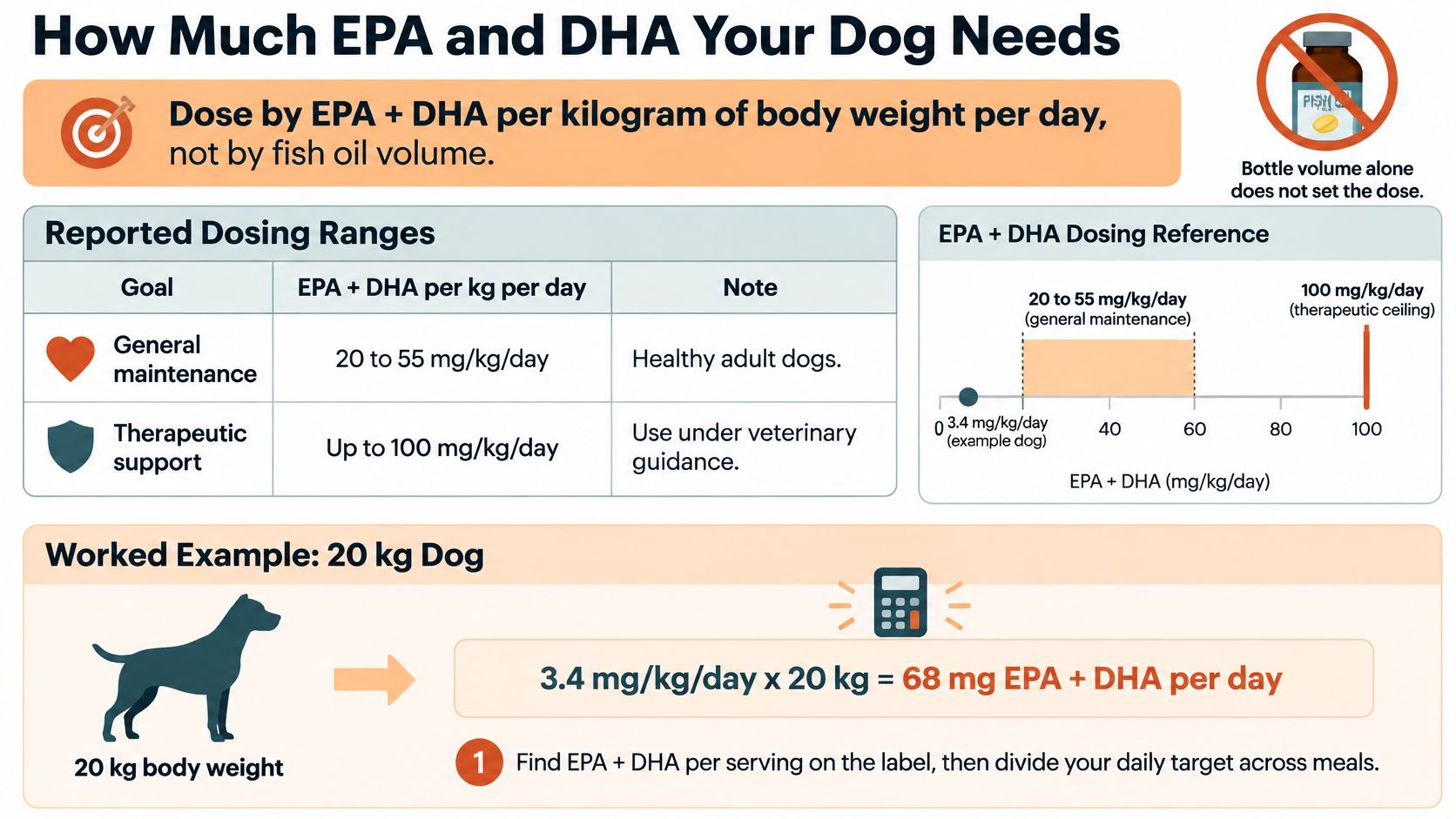
Published amounts vary because studies have examined different conditions and goals. A veterinary literature summary in JAVMA reports an osteoarthritis-oriented intake range of approximately 230 to 370 mg of combined EPA plus DHA per kg per day. It also describes a six-month trial comparing a therapeutic diet containing 3.47% omega-3 fatty acids with a control diet containing 0.11%. That diet comparison is not directly interchangeable with a supplement dose.
| Source or study | EPA plus DHA per kg per day | Context |
|---|---|---|
| Osteoarthritis target in veterinary literature | 230-370 mg | Combined EPA plus DHA target; depends on product content and dog's condition |
| Osteoarthritis, 2025 systematic review | 68-132 mg | Summed from EPA 48-100 mg and DHA 20-32 mg per kg |
| Osteoarthritis trial with positive results | about 69 mg | 78 dogs, triglyceride form, 84 days |
| 2024 U.S. study | about 68 mg | 16 weeks; Omega-3 Index rose from 1.4% to 3.3% |
| Dermatology, 2025 systematic review | 1.65-73 mg | Summed from EPA 0.99-43 mg and DHA 0.66-30 mg per kg |
| Trial with no major pain benefit | 110 mg | 77 dogs, 16 weeks; 90 mg EPA and 20 mg DHA; 5.4 mg ETA excluded from sum |
The osteoarthritis review reported effective ranges of 48 to 100 mg/kg EPA and 20 to 32 mg/kg DHA in the 2025 systematic review in Nutrition Research Reviews. For dermatology, the PubMed record for that review gives 0.99 to 43 mg/kg EPA and 0.66 to 30 mg/kg DHA. These ranges differ substantially, so a dose used for one condition should not automatically be applied to another.
Dose can also affect whether a study sees a change. In the 2010 dose-titration study in the Journal of Veterinary Internal Medicine, dogs received a baseline food containing approximately 0.8% EPA plus DHA, or foods with roughly twofold and threefold higher concentrations. Significant improvement in lameness, weight bearing, overall arthritic condition and arthritis progression occurred at the threefold level, not the twofold level.
A worked example you can copy
Suppose your vet agrees on a trial near 68 mg/kg/day for a 20 kg dog. Multiply 68 by 20: the target is 1,360 mg of EPA plus DHA per day. A capsule labeled 1,000 mg fish oil with 180 mg EPA and 120 mg DHA supplies 300 mg combined, so the calculation calls for about 4 to 5 capsules daily. A weaker capsule with 180 mg combined would require about 7 to 8.
The arithmetic is simple; the label is what makes it useful. Two products can list the same total fish oil while delivering different amounts of EPA and DHA. Check those two amounts, add them, then compare the sum with the daily target. Don't choose the highest published range on your own. The appropriate target depends on the dog's diagnosis, current diet and medicines, and more oil can also mean extra calories or digestive upset.
The short video below shows the same calculation, including converting a weight in pounds to kilograms before multiplying.
Consistent dosing can change measured blood levels, but that does not establish a universal target. A 2025 systematic review summary in GeroScience describes a 2024 U.S. study using approximately 68 mg EPA plus DHA/kg/day for 16 weeks. The average Omega-3 Index rose from 1.4% to 3.3%. The authors said condition-specific target Omega-3 Index levels and optimal doses remain undefined, so treat published ranges as a starting point for a dosing discussion with your vet.
Where the Evidence Falls Short
Two osteoarthritis trials point in different directions, and that conflict is useful. One prospective, randomized, double-blind, placebo-controlled trial summarized on PubMed gave 78 dogs triglyceride-form omega-3 oil providing an average of 69 mg EPA plus DHA/kg/day. After 84 days, discomfort, lameness and joint severity improved significantly versus placebo.
Another randomized, placebo-controlled study in that summary gave 77 dogs approximately 90 mg EPA, 20 mg DHA and 5.4 mg ETA/kg/day. After 16 weeks it did not find a major statistically significant pain-relief benefit. A higher combined EPA plus DHA number therefore didn't guarantee a better owner-visible result.
Why results can disagree
Dogs differ in joint damage, body condition, activity, pain scoring and other treatments. Products differ in fatty acid form, freshness, concentration and how reliably owners give them. Outcome measures also differ, from force-plate weight bearing to owner questionnaires, and those tools don't always move together.
Reviews face the same problem. Doses, durations and patient characteristics vary widely, and dosage reporting is sometimes incomplete. That limits how confidently anyone can promise that a specific bottle will reproduce a specific trial.
Fish oil is a possible adjunct, not a guaranteed analgesic. A fair trial needs a defined dose, enough time and a way to judge change.
Three claims to correct
- More capsules always means more benefit: Dose matters, but benefit isn't guaranteed at any level, and digestive or bleeding concerns become more important as intake rises.
- A shiny coat proves joints are helped: Skin and joint outcomes involve different tissues and doses, so coat shine isn't evidence that arthritis pain has changed.
- Fish oil can replace core care: It doesn't replace tooth brushing, allergy diagnosis, weight control, rehabilitation or prescribed pain management.
Keep expectations modest. Look for easier rising, slightly better walking tolerance, less itch or improved coat texture over several weeks, not a dramatic overnight change. If there's no measurable improvement by the review point you set with your vet, continuing just because fish oil sounds natural isn't a strong reason.
How to Judge a Fish Oil Label Before You Buy
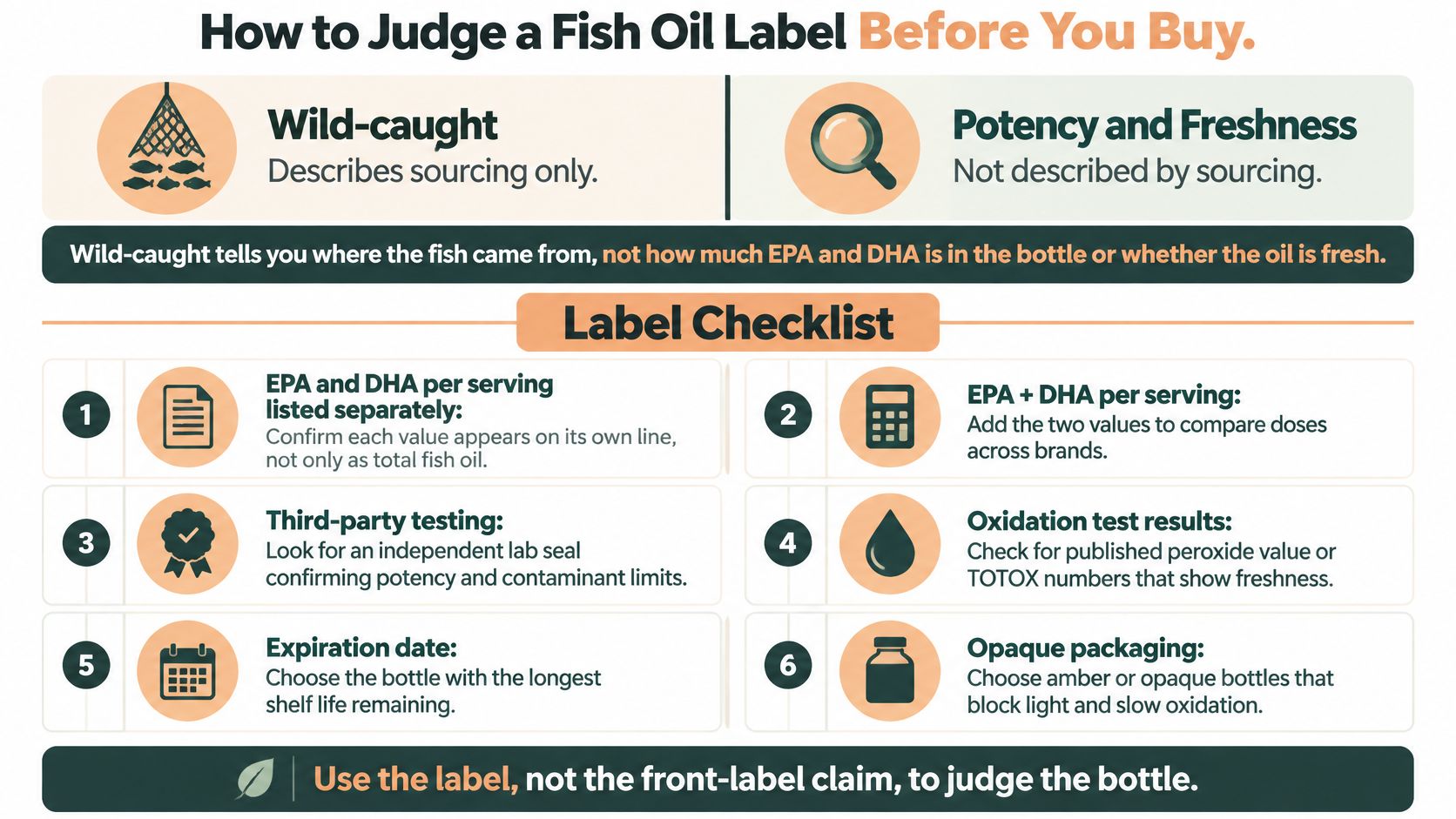
Wild-caught describes sourcing, not potency or freshness. It identifies where the fish came from, but not how much EPA and DHA the finished oil provides or whether it has been protected from spoilage.
Use the checklist below when comparing a store label or online listing. The order matters: first check what active omega-3s a serving supplies, then look at testing, freshness and sourcing.
A systematic review in In Vivo reported potential benefits of omega-3s for canine allergic dermatitis, haircoat disorders, dry eye, valvular disease and osteoarthritis. It also noted that doses varied and reporting was sometimes incomplete. Clear EPA and DHA amounts let you compare a product with the doses used in research, even though the review does not establish that every product will produce the same results.
Your six-point label check
- EPA and DHA listed separately: Look for milligrams of each per capsule, pump, teaspoon or chew. Total fish oil alone does not tell you how much of either fatty acid the serving contains.
- A calculable serving: Check that you can add EPA and DHA, then calculate the combined amount per kilogram using your dog's weight.
- Independent or lot-specific testing: Look for verifiable testing of contaminants and oxidation, rather than a general purity statement. Testing should cover concerns such as dioxins, pesticides, mycotoxins and heavy metals.
- Freshness controls: Check the expiry date, storage directions and packaging. Light, air and poor storage can affect oil quality.
- Named species and origin: Pollock, salmon, anchovy or another named fish gives more information than a label that says only “fish oil blend.”
- Recognized quality programs: Look for clear information about quality programs, such as National Animal Supplement Council participation, which adds accountability.
A brand should be able to explain what it tests and how often. If that information is missing, claims about flavor or a low price do not make the label more useful.
Red flags and a generic label test
Avoid an omega blend that gives no separate EPA and DHA amounts. Treat promises to cure arthritis, allergies or dental disease skeptically, and be wary of labels with no lot, expiry or testing information. A sharp, paint-like or strongly rancid smell is a reason not to use the oil.
Consider a label that lists 2,000 mg of fish oil per two pumps but gives no EPA or DHA figures. You cannot calculate the active dose or compare cost per milligram. A second label might state 450 mg EPA and 300 mg DHA per pump. That serving provides 750 mg combined, a figure you can compare directly with your dog's target.
Check vitamin content as well. Cod liver oil and some human fish-oil products can contain high levels of vitamins A and D, so they are not automatically interchangeable with dog fish body oil. This distinction is particularly relevant for small dogs and long-term daily use.
For a side-by-side comparison, review these fish oil options for dogs using the same checks for EPA plus DHA and testing. Choose a product whose label states how many milligrams of EPA and DHA each serving provides.
Fish Oil Form, Cost and Storage
Form affects convenience, freshness and how easily you can hit a milligram target. Liquid oil lets you adjust dose by pump or measured volume, which helps with small dogs and gradual increases. Softgel capsules protect oil from air until use, but a large dog may need several capsules a day and some dogs refuse them. Chews are easy to give, yet each chew may contain much less EPA plus DHA than its size suggests, so count milligrams first.
Labels may name triglyceride form or ethyl ester form. Don't assume the form from the price or bottle design, check the supplement facts or ask the maker. The form doesn't rescue a product that's underdosed, rancid or vague about EPA and DHA.
Calculate monthly cost from the active dose
Use this order. First find your dog's daily EPA plus DHA target in milligrams. Divide it by EPA plus DHA per capsule, pump or chew, then round up to whole units if the product can't be split.
Cost formula: Units per day times price per unit times 30 days equals monthly cost.
For example, a 20 kg dog with a 1,360 mg daily target needs 4.5 capsules if each supplies 300 mg combined. Rounded to 5 capsules at $0.30 each, that's $1.50 a day or about $45 a month. A cheaper bottle with half the EPA plus DHA per capsule could cost more per useful milligram because you use twice as many units.
Store it like a fragile fat
Keep fish oil away from heat and light, close it tightly and refrigerate after opening if the label tells you to. Use it before the expiration date and buy a size your dog will finish while it's fresh. Discard oil with a sharp or rancid smell, even if some remains, because oxidized oil isn't the product you intended to feed.
Side Effects, Risk Groups and a Safe Start
The higher the dose and the more complex your dog's health, the more your vet should lead the decision. Fish oil is still fat, and EPA and DHA can affect blood clotting pathways. That doesn't make it unsafe for every dog, but it does mean natural isn't the same as risk free.
Side effects to watch for
- Vomiting or diarrhea: These are the most common early problems, especially when owners start at full dose or give oil without food.
- Reduced appetite: Nausea, taste dislike or stomach discomfort can make a dog leave meals.
- Unusual bruising: New bruises, bleeding gums or slow clotting need prompt veterinary advice.
- Pancreatitis-like signs: Repeated vomiting, abdominal pain, hunched posture, weakness or refusal to eat mean stop and call your vet at once.
Fishy breath and loose stool are often dose related. If mild digestive signs appear, don't push through and increase the amount. Pause, tell your vet what dose you reached and ask whether to restart lower, split the dose across meals or stop completely.
Dogs who need veterinary review first
Dogs with a pancreatitis history, fat intolerance, obesity or hyperlipidemia need individual fat budgeting. Dogs with bleeding disorders, or those taking anticoagulant or antiplatelet drugs, need a clotting risk discussion before supplementation. Planned surgery or dental work also needs a timing plan, so ask whether fish oil should pause and for how long.
Tell your vet about NSAIDs and every other medicine or supplement your dog receives. Mention fish-based or marine omega-3 enriched food too, since adding oil on top can push total intake higher than intended. If you're deciding whether supplements belong in the routine at all, the guide on whether your dog needs supplements helps separate a targeted need from general wellness spending.
A seven-step safe start
- Confirm the diagnosis: Know whether you're treating osteoarthritis, allergic itch, dry coat or another problem, because the goal and dose differ.
- Screen the risks: Share pancreatitis history, bleeding issues, medicines, weight concerns and planned procedures with your vet.
- Choose a transparent product: Pick one that states EPA and DHA per serving and gives testing, lot and expiry information.
- Agree the target: Set EPA plus DHA in mg per kg, then calculate total daily milligrams from your dog's current weight.
- Start low with food: Begin at about half the target for a few days with a meal, then move up only if stool and appetite stay normal.
- Monitor for two weeks: Watch closely for vomiting, diarrhea, appetite change, bruising or pancreatitis-like signs.
- Reassess around week 6: Judge the agreed outcome with your vet and adjust, continue or stop based on what changed.
Keep a simple log while you test it. Record body weight, product name and lot number, daily EPA plus DHA in milligrams, stool quality and one weekly score for mobility or itch. For mobility, note rising from rest, stairs and walk length. For itch, note scratching, paw licking and sleep disturbance.
That record turns a vague impression into a decision. If your dog is brighter, moves more willingly or scratches less at a dose that's well tolerated, you have a reason to continue. If nothing changes, or side effects outweigh a small gain, you have a clear reason to stop and redirect effort toward diagnosis, weight, pain control, allergy care or rehabilitation.
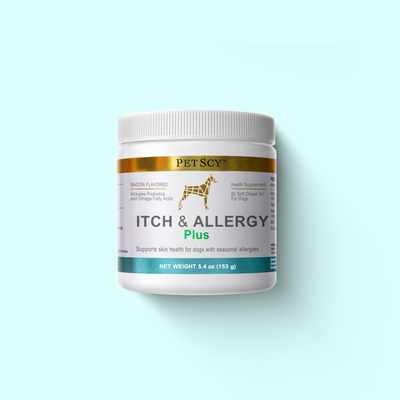
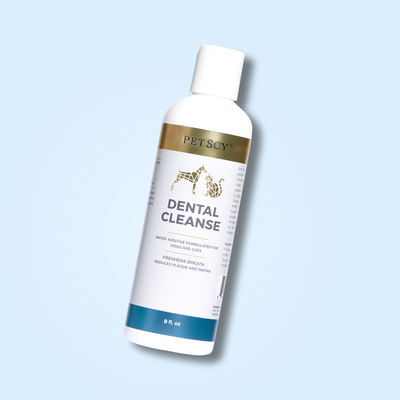
PetScy offers veterinarian-formulated dog supplements, including Fish Oil with EPA and DHA, alongside products for itch, joints, digestion, dental care and skin and coat support. Before you buy, compare the stated EPA plus DHA per serving with the mg per kg target you discussed with your vet, then visit PetScy to review the product details and choose the option that fits your dog's plan.