
















Fish Oil for Dogs Dosage Chart: Owner's Guide
A practical therapeutic benchmark is about 50 to 220 mg of combined EPA plus DHA per kilogram of body weight per day, depending on the condition, not the total fish oil printed on the front of the bottle. A 10 lb, 4.5 kg dog may fall near 225 to 990 mg of EPA plus DHA daily, while a 50 lb, 22.7 kg dog may fall near 1,135 to 4,994 mg daily for therapeutic use, with the final target set by your veterinarian.
That range is broad because fish oil isn't a single-purpose product. The appropriate amount depends on whether you're supporting general nutrition, managing itchy skin, or working toward a veterinary orthopedic goal. The bottle's “1,000 mg fish oil” claim can also mislead you, because the useful active ingredients are EPA and DHA, and their concentration varies substantially between products.
The chart below gives you a practical starting framework. Use it to translate your dog's weight and health goal into a daily EPA plus DHA target, then match that target to the supplement facts panel. For a diagnosed condition, medication interaction, or higher therapeutic dose, your veterinarian should make the final decision.
Table of Contents
- How to Use This Fish Oil for Dogs Dosage Chart
- Why EPA and DHA Matter More Than Total Fish Oil
- Fish Oil for Dogs Dosage Chart by Weight and Condition
- What the Dosage Ranges Mean for Common Conditions
- How to Read Fish Oil Labels Like a Veterinarian
- Safety, Side Effects, and When to Pause
- How to Choose a Quality Fish Oil for Dogs
- How to Start and Adjust Fish Oil Safely
- Putting It All Together
How to Use This Fish Oil for Dogs Dosage Chart
Begin with your dog's current weight and the product's active ingredients. Add the EPA and DHA listed on the supplement facts panel, then compare that combined amount with the daily target for your dog's size and health goal. The total fish oil number describes the carrier oil, not the amount of omega-3 your dog receives.
Veterinary references use more than one dosing model because the target changes with the condition being addressed. Therapeutic ranges may be expressed as approximately 50 to 220 mg of combined EPA and DHA per kilogram of body weight daily, while another model uses 230 mg per kilogram of metabolic body weight, kg^0.75. The cited safe upper limit is 370 mg/kg^0.75 per day, according to the veterinary review in Today's Veterinary Practice. These figures are reference points, not automatic instructions for every dog.
A simple way to use the chart
- Weigh your dog accurately. Use current body weight rather than an old estimate or breed average.
- Choose the purpose. General nutritional support and therapeutic joint care may require different targets.
- Find EPA and DHA. Locate both amounts on the supplement facts panel before using the headline oil weight.
- Add them together. This is the EPA plus DHA supplied by one capsule, pump, or measured volume.
- Set the serving size. Divide the target by the product's combined EPA and DHA per capsule, pump, or measured volume.
A label that omits separate EPA and DHA amounts does not provide enough information for a dependable calculation.
Use this fish oil for dogs dosage chart as a reference tool, not a medical order. Ask your veterinarian to set the final target for a diagnosed condition, a dog taking other medications, or a plan approaching the higher end of a therapeutic range.
Why EPA and DHA Matter More Than Total Fish Oil
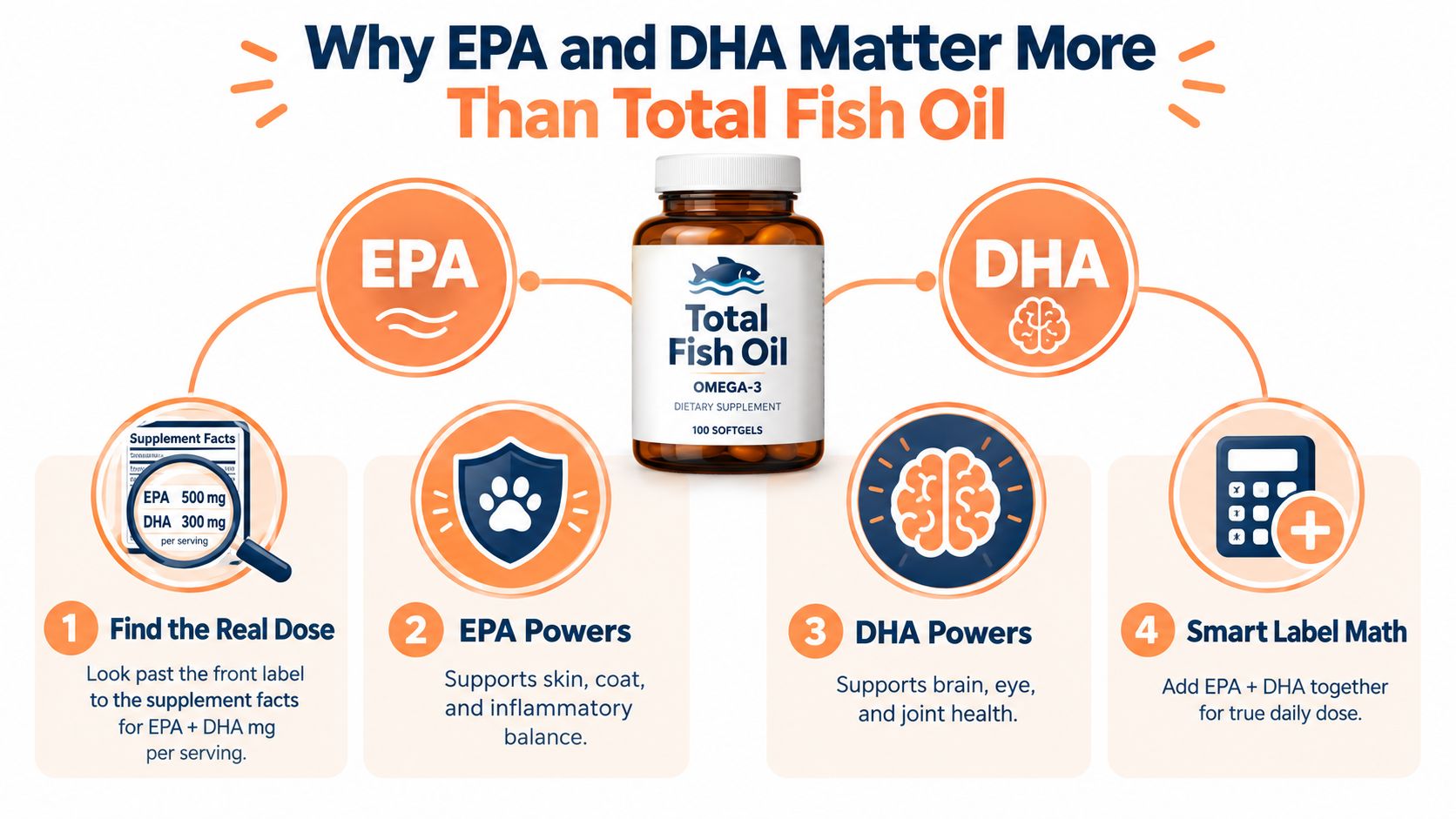
A fish oil label can display a large total-oil number while providing a much smaller amount of the omega-3s you need to measure. EPA, or eicosapentaenoic acid, and DHA, or docosahexaenoic acid, are the active fatty acids used for canine dosing. A bottle might describe the total oil in milligrams, but that number includes the delivery oil around those fatty acids.
The distinction matters because concentration varies. One softgel may contain a modest amount of EPA and DHA in a larger volume of standard oil, while a concentrated liquid may reach the same active target with a much smaller measured serving. If you dose both products by their total oil claim, one dog may receive too little and another may receive more than intended.
Wild-caught sources such as Alaskan pollock and salmon can provide useful omega-3 profiles, and sourcing can also matter to owners who want a product with a clear sustainability focus. Still, the source name doesn't replace label reading. “Salmon oil” or “fish oil” tells you where the oil comes from, not how much EPA and DHA your dog receives.
Why metabolic weight enters the calculation
Dogs don't scale linearly as they get larger. A flat milligram-per-pound rule treats every pound as if it creates the same physiological demand, but veterinary dosing references often use metabolic body weight, written as kg^0.75, to account for differences between smaller and larger animals. That produces a more structured comparison across body sizes.
Colorado State University's veterinary chart uses an osteoarthritis ceiling of 310 mg/kg^0.75 per day of combined EPA and DHA. Its examples include 574 mg for a 5 lb dog, 965 mg for a 10 lb dog, and 1,308 mg for a 15 lb dog. Those figures show why a carefully calculated target is more useful than choosing an arbitrary number of capsules. You can review the underlying chart at Colorado State University's canine fish oil dosing guide.
The useful mental model is simple: total fish oil is the vehicle, EPA and DHA are the measured payload, and metabolic weight helps create a fairer dosing framework across dog sizes.
Fish Oil for Dogs Dosage Chart by Weight and Condition
Use the table as a starting reference, not a prescription. The therapeutic column reflects a broad veterinary range of approximately 50 to 220 mg/kg of body weight daily. The maintenance column is more conservative because a complete diet may already supply some fatty acids. Your veterinarian should set the target according to the medical goal, current diet, and the product's actual EPA plus DHA content.
| Dog Weight | Maintenance Range | Therapeutic Range |
|---|---|---|
| 5 lb, 2.3 kg | About 115 to 230 mg EPA plus DHA daily | About 115 to 506 mg daily |
| 10 lb, 4.5 kg | About 225 to 450 mg daily | About 225 to 990 mg daily |
| 15 lb, 6.8 kg | About 340 to 680 mg daily | About 340 to 1,496 mg daily |
| 25 lb, 11.3 kg | About 565 to 1,130 mg daily | About 565 to 2,486 mg daily |
| 50 lb, 22.7 kg | About 1,135 to 2,270 mg daily | About 1,135 to 4,994 mg daily |
| 75 lb, 34 kg | About 1,700 to 3,400 mg daily | About 1,700 to 7,480 mg daily |
| 100 lb, 45.4 kg | About 2,270 to 4,540 mg daily | About 2,270 to 9,988 mg daily |
These ranges are reference points, not instructions to use the highest amount. A veterinarian may select a lower target for a dog eating a calorie-restricted diet, taking medication, or having a condition that increases bleeding or digestive concerns. A gradual, monitored approach also makes it easier to identify whether loose stools or vomiting comes from the dose, the oil, or another change.
Body size does not always fit a simple per-pound formula. The CSU osteoarthritis chart uses metabolic weight, which changes how the target scales between smaller and larger dogs. Its examples include 965 mg for a 10 lb dog and 1,308 mg for a 15 lb dog. These figures demonstrate why the label's concentrated EPA plus DHA amount matters more than the number of capsules.
Start by selecting the intended daily target, then divide it by the EPA plus DHA supplied per serving. If the result falls between measured doses, ask your veterinarian whether rounding down, splitting the serving, or choosing a more concentrated product is safer.
Owners comparing fish oil with other wellness options may also find this overview of the benefits of CBD chews for dogs useful when discussing supplements with a veterinarian. CBD chews serve a different purpose and should not replace a clearly calculated EPA and DHA dose.
What the Dosage Ranges Mean for Common Conditions
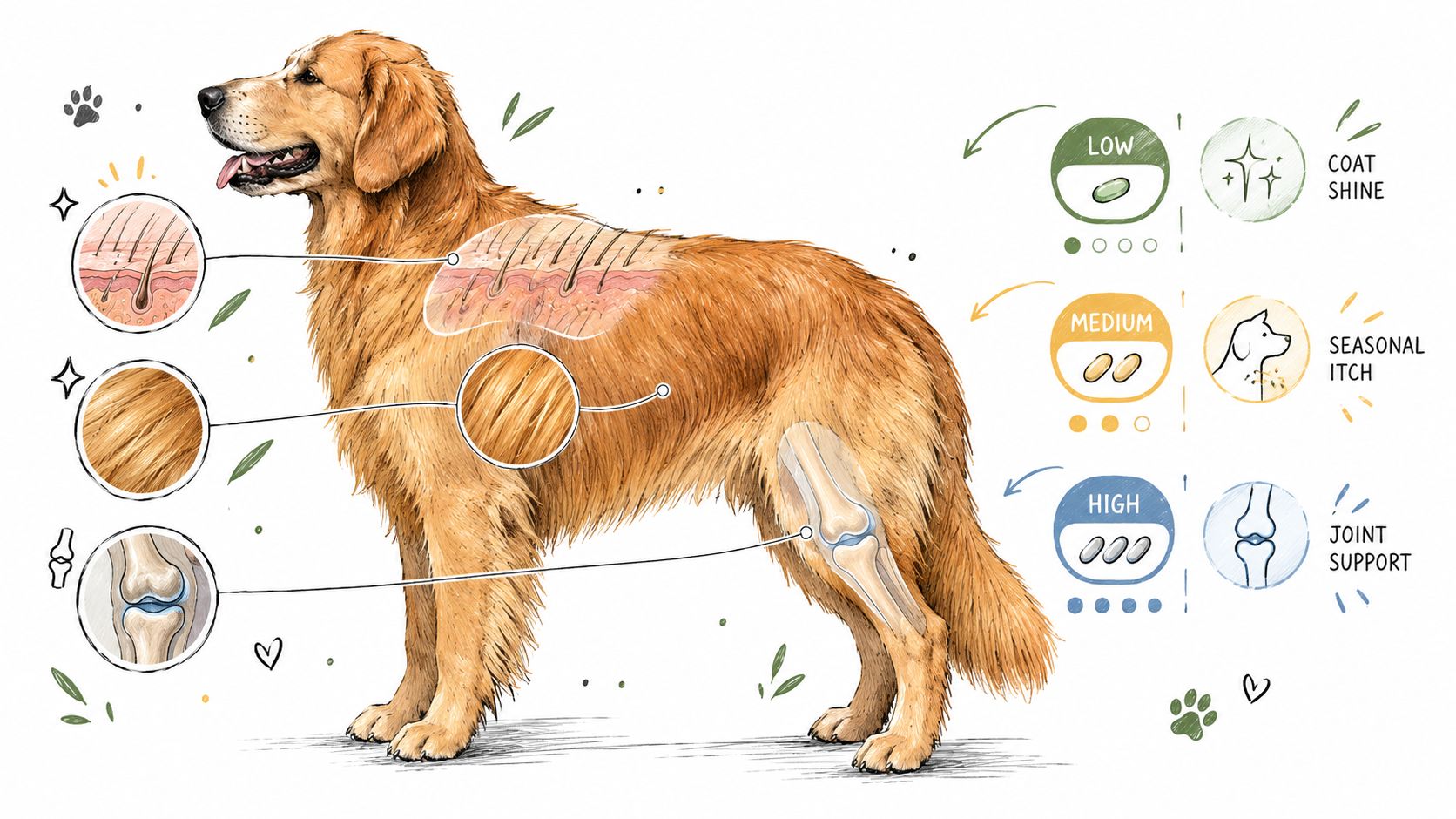
The lower end of a range generally fits a dog whose diet needs modest omega-3 support, such as everyday skin and coat maintenance. You might notice a softer coat or less visible dryness over time, but fish oil isn't a cure for infection, parasites, food allergy, or an underlying endocrine disorder. A dog with persistent itching still needs a proper examination rather than an escalating supplement dose.
Seasonal itching creates a different decision. EPA and DHA may support a healthy inflammatory balance and skin barrier, but the target depends on how intense the signs are, what the dog eats, and whether other treatments are already in use. For a useful discussion of the question, see whether omega-3 helps dogs with itching. Give a stable dose long enough to judge the response instead of changing products and amounts every few days.
Matching the target to the goal
- Skin and coat support: Start with the lower part of the appropriate reference range unless your veterinarian recommends otherwise.
- Seasonal itch support: A middle or higher target may be considered when ordinary maintenance support isn't enough, but the skin diagnosis still matters.
- Orthopedic support: Joint goals often require a therapeutic plan, and the CSU osteoarthritis ceiling should be treated as a veterinary reference rather than a home dosing challenge.
- Cognitive or developmental support: DHA has a distinct biological role, but the product's complete formulation and the dog's life stage should guide selection.
The most useful outcome measures are practical ones. Track scratching, paw licking, coat condition, willingness to rise, and ease of movement. Fish oil works as part of a longer routine, so a single good or bad day shouldn't determine the next dose.
A measured serving also matters more than the format. Liquid oil can be mixed into food, while softgels may be easier for some households to store and administer. Neither format is automatically safer. The EPA and DHA concentration, freshness, total calories, and medical context decide whether it fits your dog.
How to Read Fish Oil Labels Like a Veterinarian
Turn the bottle to the supplement facts panel before you count capsules. Look for separate lines labeled EPA and DHA, and note whether the quantities apply to one capsule, one pump, one teaspoon, or another serving size. Then add the two values together.
Suppose a label lists 180 mg of EPA and 120 mg of DHA per softgel. The usable dose is 300 mg of combined EPA plus DHA per softgel, not the total oil amount printed elsewhere on the package. If your veterinarian chooses a daily target of 900 mg, the calculation is target divided by active content per serving, not target divided by total fish oil.
A label verification checklist
- Serving basis: Confirm exactly what “per serving” means.
- Active amounts: Find EPA and DHA as separate line items.
- Concentration: Compare combined EPA plus DHA between products.
- Ingredients: Check for unnecessary flavorings or unsafe additives.
- Testing: Look for credible verification of identity, purity, and oxidation.
- Storage: Follow the product's instructions, especially after opening a liquid.
A standard oil may require more liquid or more softgels to reach the same target as a concentrated formula. That can affect cost, palatability, storage, and the number of calories added to the meal. A liquid gives you flexible measurement, but inaccurate droppers or casual pouring can create inconsistent dosing. Softgels provide a fixed amount, but splitting a target may be awkward when the capsule's EPA and DHA content doesn't line up neatly.
If the label lists only “omega-3” without identifying EPA and DHA, treat the product as difficult to dose accurately. You can ask the manufacturer for a certificate of analysis or choose a formula with transparent active-ingredient disclosure. Guidance on verifying supplement claims is available in this resource on third-party testing for product verification.
Safety, Side Effects, and When to Pause
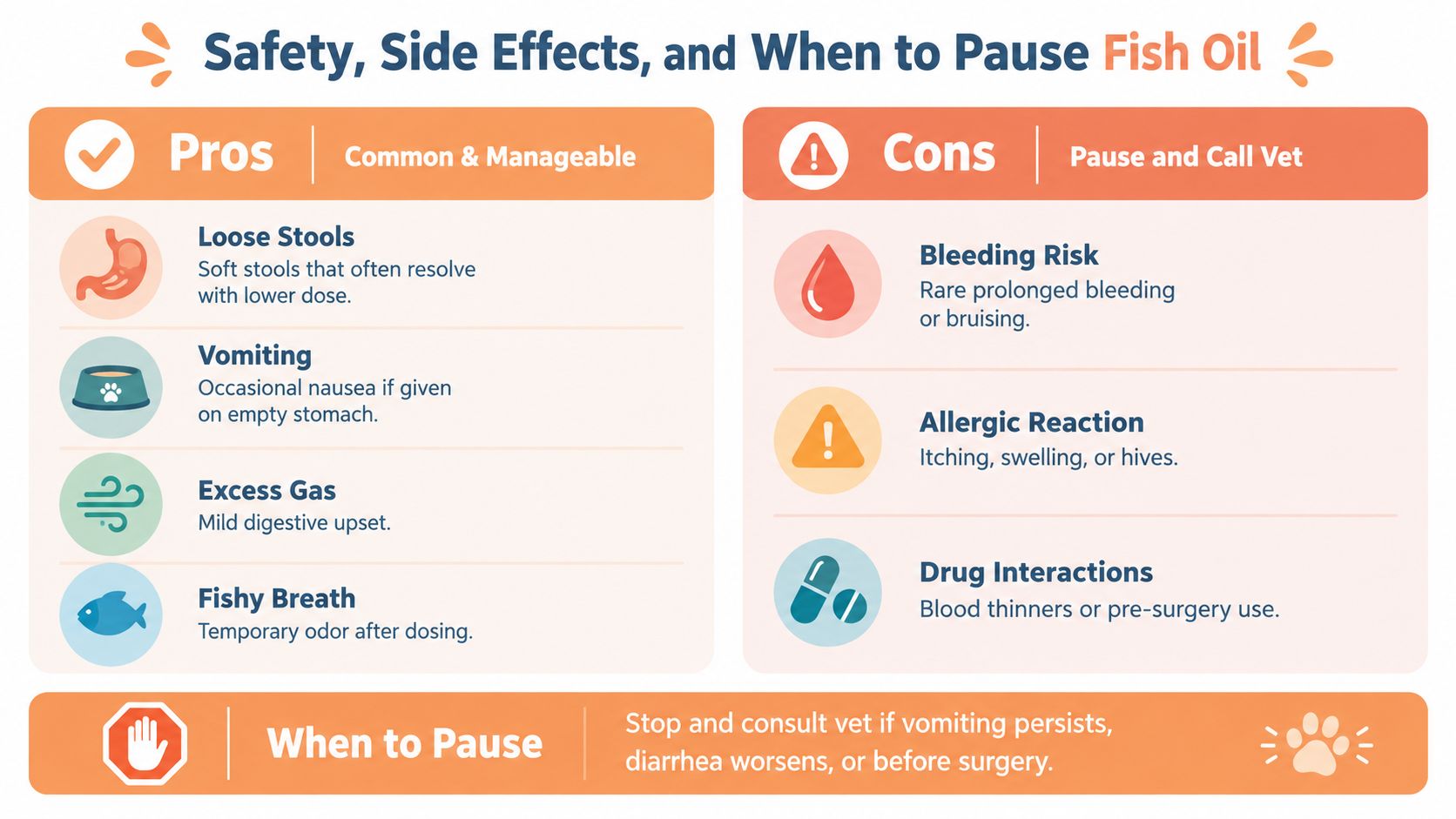
A dosage chart can't capture every risk. The common adverse effects reported by the American Kennel Club's fish oil guidance include diarrhea, vomiting, excess gas, and fishy breath. These problems often appear when an owner starts too high, increases too rapidly, or gives a serving that doesn't suit the dog's diet.
Start by looking at the pattern. A mild change in stool after a new supplement may improve when the amount is reduced and given with food, but ongoing vomiting, worsening diarrhea, marked lethargy, or refusal to eat calls for a veterinary conversation. Don't keep increasing the dose in the hope that digestive upset will disappear.
Situations that need extra caution
- NSAIDs or anticoagulants: Ask the prescribing veterinarian before adding therapeutic fish oil, because rare increased bleeding risk matters more when clotting is already affected.
- Upcoming surgery: Discuss the supplement in advance rather than waiting until the procedure date.
- Clotting concerns: Bruising, prolonged bleeding, or a known bleeding disorder warrants professional direction.
- Calorie restriction: Fish oil adds fat calories, so the serving may need to fit into the dog's overall diet plan.
- Sensitive digestion: A liquid, softgel, or concentrated formula may be tolerated differently, even when the EPA plus DHA target is similar.
Rare bleeding risk doesn't mean every dog must avoid fish oil. It means the medical context should determine the dose.
The veterinary review used for dosing also emphasizes that safe ceilings can vary with diet calories and clinical circumstances. A therapeutic target should therefore remain under professional supervision, particularly when your dog takes medication or has chronic disease. Pause the supplement and contact your veterinarian if you see unusual bleeding, persistent gastrointestinal signs, swelling, hives, or a sudden decline in energy.
How to Choose a Quality Fish Oil for Dogs
The label must support the dose you intend to give. A product that advertises total oil but hides EPA and DHA leaves you estimating, and estimation is where dosing errors begin. Choose a formula that states the active fatty acids clearly and identifies the serving measurement.
Quality verification matters because fish oil can vary in freshness, purity, and concentration. Look for third-party testing, a transparent certificate of analysis when available, and quality signals such as National Animal Supplement Council membership. Wild-caught sourcing, including products based on Alaskan pollock or salmon, may also appeal to owners who want a stated sustainability focus, but sourcing alone isn't proof of potency.
Veterinarian-formulated products made in the United States with globally sourced ingredients are one category to consider. The deciding factors should still be the same: active-content disclosure, appropriate testing, sensible packaging, and a serving you can measure consistently. If you're comparing alternatives, this guide can help you choose between fish and krill oil according to format and label information.
Compare two bottles using four questions
- Which product lists the greater combined EPA and DHA per actual serving?
- Can you measure that serving accurately for your dog's target?
- Does the manufacturer provide credible purity and oxidation verification?
- Will the format fit your dog's appetite, calorie plan, and storage routine?
PetScy's fish oil guide for dogs is another resource for evaluating a product around these criteria. PetScy sells a veterinarian-formulated fish oil sourced from wild-caught Alaskan pollock and salmon, with EPA and DHA identified as relevant omega-3 components. Treat those product details as starting points for label comparison, not as a reason to skip the dose calculation.
How to Start and Adjust Fish Oil Safely
Don't begin at the top of a therapeutic range. Start below the intended target, give the supplement with food, and increase gradually only if your dog tolerates it. This approach reduces the chance that a sudden change in dietary fat will trigger loose stool or vomiting.
Use a simple observation cycle:
- Record the baseline. Write down body weight, current food, stool quality, scratching, coat condition, and mobility.
- Add a modest serving. Use the product's EPA plus DHA amount to calculate what your dog receives.
- Hold the dose. Keep the serving stable long enough to distinguish tolerance from a temporary digestive change.
- Increase only with a reason. Move toward the veterinarian's target if the dog is tolerating the supplement and the health goal justifies it.
- Pause when signs worsen. Contact your veterinarian if digestive symptoms persist, bleeding appears, or the dog seems unwell.
A written log prevents dose drift. Record the date, product, serving size, combined EPA plus DHA, stool score, appetite, energy, itch behavior, and movement. This is especially useful when a dog takes other supplements or medications, because it helps your veterinarian identify what changed and when.
Dogs with chronic disease, dogs taking NSAIDs or anticoagulants, and dogs being treated for orthopedic or dermatological problems should have the target reviewed before increasing. Consistency matters more than speed. A slowly introduced dose that your dog receives reliably is more useful than an ambitious dose that causes digestive upset and gets stopped.
Putting It All Together
A dependable fish oil plan rests on four decisions. Read EPA and DHA, because total oil doesn't tell you the active dose. Select a weight- and condition-appropriate target, using the chart as a reference rather than treating it as a prescription.
Next, verify the product. Look for transparent active-ingredient amounts, credible testing, suitable sourcing, and a format you can measure. Finally, introduce the supplement gradually and track stool quality, appetite, coat, itching, and mobility.
The most responsible approach isn't the most aggressive one. It's a consistent, measured routine that respects your dog's diet, medications, and medical history. For therapeutic dosing, your veterinarian remains the final authority.
PetScy offers veterinarian-formulated supplements and topical care products, including a fish oil product designed to be given over food during mealtime. Visit PetScy to compare its fish oil and broader canine wellness options, then use the EPA plus DHA label information with your dog's weight and veterinary plan.