














Joint Stiffness & Mobility Loss — Supports Comfort & Daily Activity.
Your Labrador pauses at the back door, places each paw carefully on the kitchen tile, and takes longer than usual to settle after a familiar game of fetch. He may still greet you enthusiastically and chase the ball, but those small delays are meaningful. A dog doesn't need to limp dramatically for joint stiffness and mobility loss to affect comfort and daily activity.
Joint trouble isn't reserved for visibly elderly dogs. It can appear during mid-life, after an injury, alongside poor joint structure, or in a dog whose body carries more weight than its joints can comfortably manage. The right response isn't panic, and it isn't dismissal. It's a careful look at patterns, activity, pain, and function.
This guide explains what stiffness means, which early signs owners commonly overlook, how veterinarians investigate the root cause, and how exercise, weight control, home changes, and nutrition work together. It also separates supplement ingredients with meaningful current evidence from legacy formulas that often receive more marketing attention than scientific support. PetScy Longevity Joint & Immune Chews and Fish Oil can fit into that layered plan, but they should complement veterinary care, not replace diagnosis or prescribed pain control.
Table of Contents
- Why Your Dog's Slow Mornings Deserve a Closer Look
- What Joint Stiffness and Mobility Loss Actually Mean
- Early Signs Owners Often Miss in Active Dogs
- How Vets Diagnose the Root Cause of Stiffness
- Which Joint Supplements Actually Have Evidence Behind Them
- Exercise, Weight, and Home Adjustments That Make a Real Difference
- How PetScy Products Fit Into a Layered Mobility Care Plan
- Dosing, Safety, Prevention, and When to Call the Vet
Why Your Dog's Slow Mornings Deserve a Closer Look
A slow morning can be easy to explain away. Your dog slept soundly, the floor is cold, or yesterday's play session was unusually energetic. But if he repeatedly hesitates before rising, walks stiffly for the first part of the day, or takes longer to lie down after exercise, you're seeing a pattern rather than a random off day.
That pattern matters because mobility decline can begin before a dog looks old. A younger or middle-aged dog may still run, jump, and play while changing how he performs those activities. He might take the stairs one step at a time, avoid the slickest part of the floor, or stop jumping into the car even though he remains eager to go for a ride.
Read function, not enthusiasm
Dogs often hide discomfort through motivation. A ball-obsessed dog may sprint despite pain, then stiffen afterward. A food-motivated dog may rise quickly for dinner but struggle after resting. The better question isn't, “Does my dog still want to play?” Ask, “How does he move before, during, and after the activity?”
Record short videos of your dog getting up, walking on a flat surface, turning, climbing stairs, and returning from a walk. A veterinarian may notice changes that are difficult to see during a brief clinic gait check, especially when excitement temporarily masks stiffness.
Practical rule: A symptom that improves after a few minutes is still a symptom. “Warming up” doesn't make the observation irrelevant.
The sections ahead focus on useful decisions. You'll learn how osteoarthritis and other orthopedic problems limit movement, which signs deserve a veterinary appointment, what diagnostic testing can reveal, and how to adjust exercise and flooring immediately. You'll also get a candid ranking of omega-3 fatty acids, green-lipped mussel, collagen, eggshell membrane, glucosamine, chondroitin, MSM, and hyaluronic acid.
The aim is simple: help your dog stay comfortable and engaged in ordinary life, from rising in the kitchen to walking around the block.
What Joint Stiffness and Mobility Loss Actually Mean
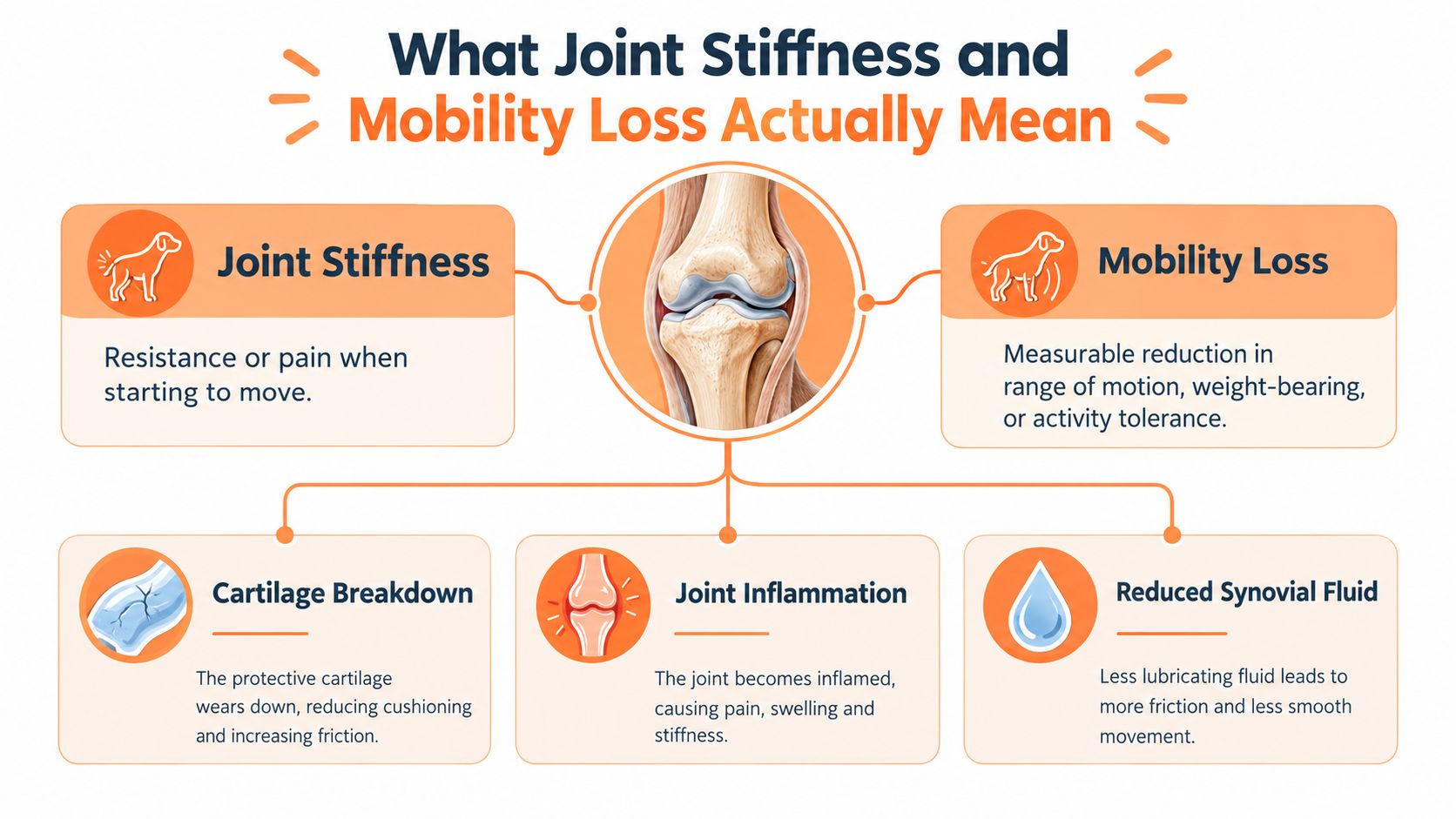
Joint stiffness is resistance, discomfort, or pain when a dog starts moving or works through a joint's range. Mobility loss is a functional reduction in range of motion, weight-bearing, stride quality, or tolerance for normal activity. These are related, but they aren't identical. A dog can have measurable joint changes while showing only task-specific difficulty, such as trouble rising or jumping.
Osteoarthritis is a common driver. Cartilage becomes less effective at cushioning movement, the joint lining can become inflamed, and the bone beneath the cartilage may remodel. Surrounding muscles can weaken when a dog protects a painful limb, which then reduces stability and makes ordinary movement harder. This cycle helps explain why stiffness can become more noticeable after rest or demanding activity.
A veterinary review reports that osteoarthritis prevalence in North America has been described at about 20% of dogs over one year of age, while a 2024 study found radiographic osteoarthritis in 39.8% of 123 young dogs aged 8 months to 4 years and clinical signs in 23.6% of those dogs. The same review describes UK primary-care records showing an annual period prevalence of 2.5%, equivalent to around 200,000 affected dogs per year. These findings support a clear conclusion: joint disease isn't exclusively a senior-dog problem. (Veterinary review of canine osteoarthritis)
Primary and secondary joint disease
Primary osteoarthritis develops without one single identifiable initiating injury. Secondary osteoarthritis follows another problem, such as cruciate ligament disease, hip dysplasia, elbow incongruity, patellar luxation, or a previous fracture. Breed structure, conformation, body condition, and exercise history can influence risk, but they don't establish a diagnosis by themselves.
If you're looking for broader guidance on managing painful degenerative joint conditions, this resource on joint pain relief Kansas City offers useful context about evaluation and treatment. Your own veterinarian should still assess your dog's specific gait, joints, and medical history before you choose a management plan.
Early Signs Owners Often Miss in Active Dogs
Active dogs create a special diagnostic trap. Their enthusiasm can conceal discomfort, and owners often notice the problem only when performance drops sharply. Don't wait for that point. Audit movement during ordinary tasks, not just during a favorite game.
During the day
Watch your dog during transitions and routine movement:
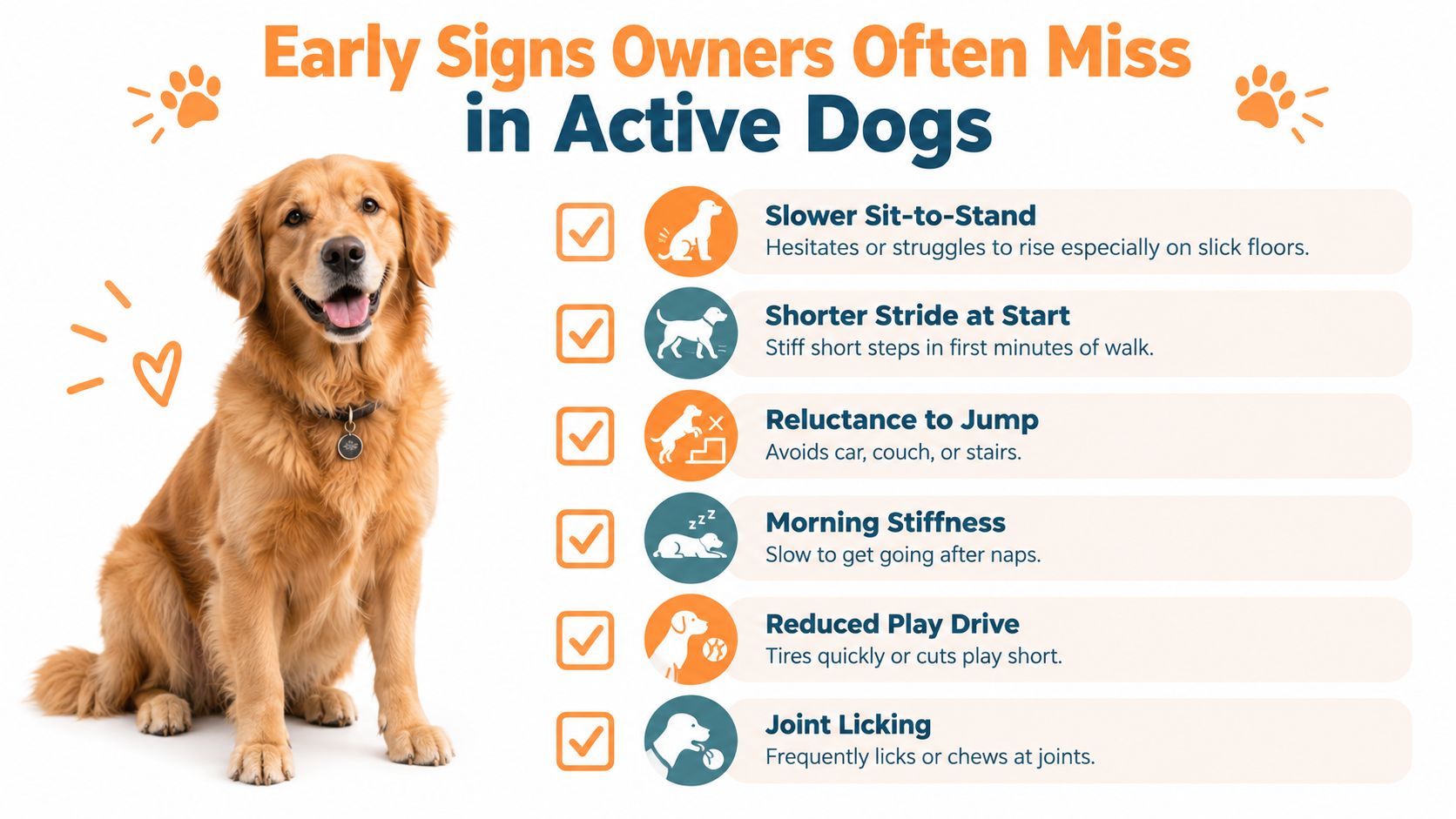
- Slower sit-to-stand: He hesitates, shifts his weight, or pushes up awkwardly, especially on tile or hardwood.
- Shorter starting stride: His first minutes of walking look tight or choppy, then improve as he moves.
- Reluctance to jump: He pauses before entering the car, avoids the sofa, or chooses stairs more cautiously.
- Morning or post-nap stiffness: He takes time to get going after rest, even if the stiffness resolves quickly.
- Slippery-surface avoidance: He detours around polished floors or spreads his toes for traction.
- Reduced play drive: He still participates but ends the game sooner, takes more breaks, or stops fetching.
The key is activity-dependent variation. A dog may move normally in a straight line yet show pain when turning, rising, jumping, or climbing. Veterinary guidance recommends assessing changes across the day and during specific tasks rather than relying on one gait observation. (Clinical signs and assessment of canine osteoarthritis)
After activity
Post-exercise clues can be more revealing than performance itself. Look for head-bobbing at a trot, a hip hike, scuffed toenails, shifting weight away from one limb, licking or chewing at a joint, or stiffness that appears after a weekend of hard play.
Keep a brief log with the activity, surface, duration in qualitative terms, and what happened afterward. Film the change if possible. A video of the first walk after rest or the moment your dog climbs out of the car may give your veterinarian better information than a description weeks later.
For a visual demonstration of subtle mobility changes, review this canine joint stiffness and mobility video.
How Vets Diagnose the Root Cause of Stiffness
A good mobility workup starts with observation, not a supplement recommendation. Your veterinarian needs to determine whether the limitation comes from a painful joint, a ligament, the spine, nerves, muscles, or a systemic illness.
The diagnostic sequence
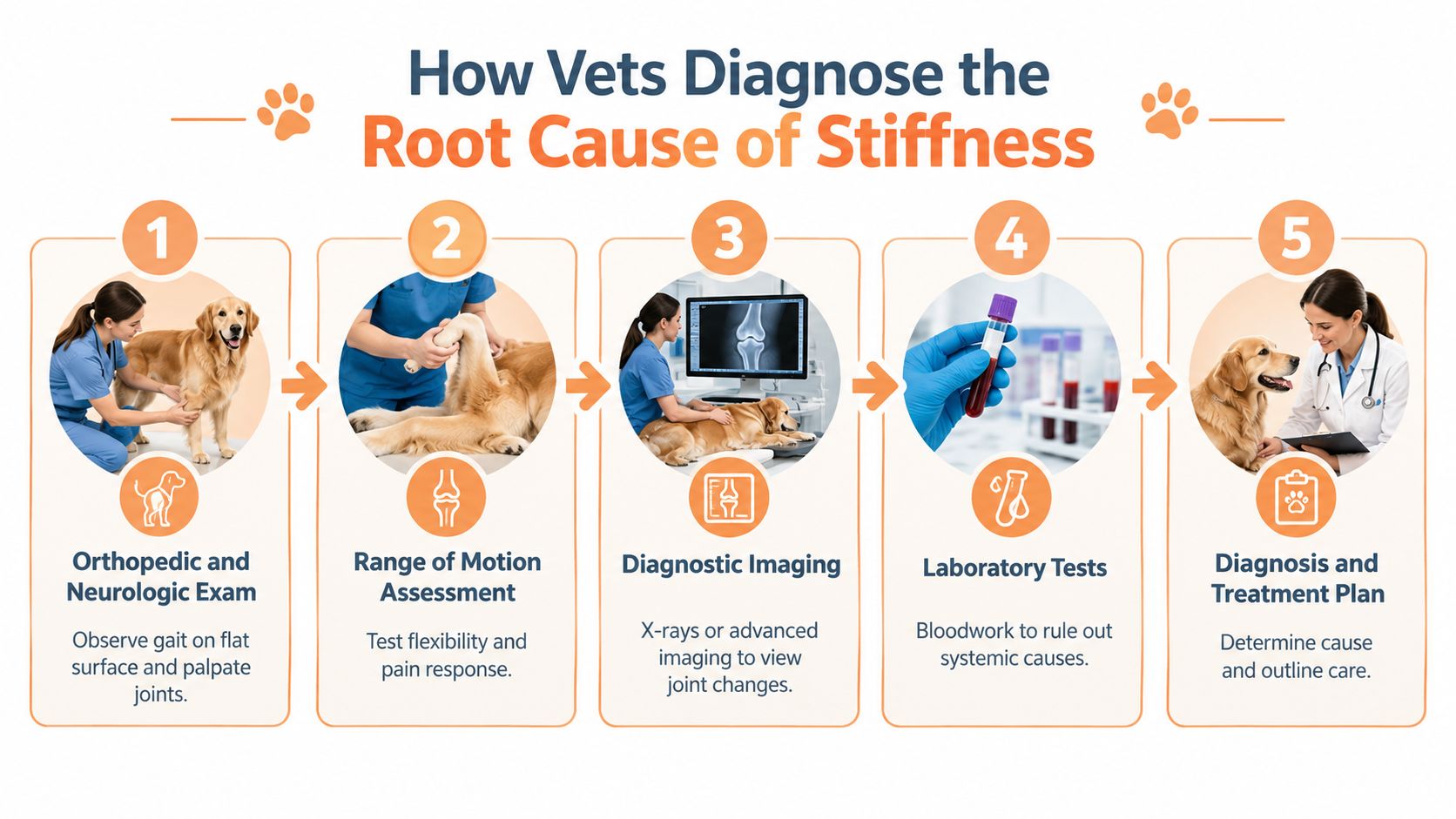
- Orthopedic and neurologic examination: The veterinarian watches your dog walk, turn, and negotiate surfaces when appropriate. They palpate joints and muscles, assess pain responses, look for swelling or crepitus, and check neurological function.
- Range-of-motion assessment: Each relevant joint is flexed and extended while the clinician evaluates resistance, asymmetry, and discomfort.
- Laboratory screening: Bloodwork and urinalysis can help identify systemic contributors and establish a safety baseline if sedation or anesthesia becomes necessary.
- Imaging: Radiographs can show osteophytes, joint remodeling, fractures, and alignment changes. CT or MRI may be needed when soft tissue, cruciate, spinal, or complex joint involvement remains unclear.
- Targeted sampling: Arthrocentesis, or collection of joint fluid, can help clarify inflammatory or infectious disease when the physical examination and imaging do not provide a complete answer.
Prepare before the appointment
Bring videos recorded at home, a list of current medications and supplements, and notes about when stiffness appears. Include recent changes in exercise, slipping, jumping, appetite, sleep, or behavior. Don't exercise your dog heavily before the appointment just to reproduce the problem. A flare can increase discomfort and make the visit harder.
A physical examination can also reveal that apparent “joint stiffness” is spinal disease, hip dysplasia, or another non-joint condition. That distinction changes treatment, so skip the guesswork and let the workup guide the plan.
Which Joint Supplements Actually Have Evidence Behind Them
Joint supplements aren't interchangeable. The current evidence review from the Pet Evidence Project gives the clearest practical hierarchy: omega-3 fish oil has strong support, green-lipped mussel has moderate support, eggshell membrane and undenatured type-II collagen have emerging support, while glucosamine and chondroitin show weak or no benefit in that review. (Evidence review of canine joint supplements)
| Ingredient | Evidence tier | Primary mechanism | Best for |
|---|---|---|---|
| Omega-3 fatty acids, EPA and DHA | Strong | Helps regulate inflammatory signaling | Dogs needing an evidence-supported nutrition adjunct for inflammatory joint discomfort |
| Green-lipped mussel | Moderate | Provides marine lipids and other joint-supportive compounds | Daily mobility support, particularly when inflammation is part of the picture |
| Undenatured type-II collagen | Emerging | Targets immune tolerance related to joint collagen | Dogs whose plans include cartilage-focused nutraceutical support |
| Eggshell membrane | Emerging | Supplies membrane-derived compounds associated with connective-tissue support | Owners seeking a targeted, nontraditional ingredient |
| Glucosamine and chondroitin | Weak or mixed | Cartilage and connective-tissue substrate support | Combination formulas, with realistic expectations |
| MSM and hyaluronic acid | Mixed or limited | Sulfur-based connective-tissue support and synovial-fluid-related support | Adjunct formulas, not substitutes for pain management |
How to interpret the ranking
Omega-3 fatty acids and green-lipped mussel deserve priority when choosing based on current evidence. They address inflammatory biology more directly than a formula built only around traditional cartilage ingredients. That doesn't make glucosamine or chondroitin automatically useless, but it does mean you shouldn't assume an impressive ingredient list equals proven clinical benefit.
The product's dose, purity, labeling, and your dog's total diet still matter. Nutraceuticals are adjuncts. A dog with moderate or severe pain may need veterinary-prescribed analgesia, rehabilitation, weight management, or surgery, depending on the cause.
For a practical overview of how owners commonly compare formulas, see this guide to senior dog joint supplements. Use it as a starting point, then ask your veterinarian to review the exact product and dose.
Exercise, Weight, and Home Adjustments That Make a Real Difference
Exercise should preserve movement without provoking a flare. Veterinary rehabilitation guidance supports controlled leash walking and swimming, along with softer, regular surfaces, ramps, and short frequent walks during exacerbations. A controlled study also found that moderate exercise could worsen hindlimb lameness in dogs with osteoarthritis, so more exercise isn't automatically better. (Veterinary rehabilitation guidance for canine osteoarthritis)
Build a kinder routine
Start with a gentle warm-up on leash, keep the route predictable, and favor flat ground. Swimming or an underwater treadmill can provide conditioning with less impact, but your dog still needs supervision, safe entry and exit, and a dose matched to pain tolerance. Avoid weekend heroics followed by prolonged rest. Consistent, manageable movement is the better strategy.
Body condition deserves equal attention. Extra load increases the demand placed on painful joints, while a leaner body reduces mechanical stress and often improves willingness to move. Ask your veterinarian to assess body condition rather than relying on a visual guess, especially in thick-coated dogs.
Change the environment
- Add traction: Place non-slip runners over tile and hardwood, especially near beds, food bowls, and doors.
- Use ramps: A ramp can replace jumping into a vehicle or climbing awkward steps.
- Choose supportive bedding: An orthopedic bed gives stiff joints a more comfortable resting surface.
- Trim nails: Overgrown nails can worsen slipping and alter paw placement.
- Adjust flare days: Shorten walks and skip fetch, jumping, and sharp turns when stiffness increases.

Feed and exercise at consistent times, then note how your dog responds later that day and the next morning. That response is more useful than a single energetic performance.
How PetScy Products Fit Into a Layered Mobility Care Plan
Mobility support works best as a stack, not a single chew. Put veterinary diagnosis, prescribed pain control, healthy body condition, and controlled exercise first. Add targeted nutrition after you understand the likely cause and your dog's medical needs.
PetScy Longevity Joint & Immune Chews combine green-lipped mussel, glucosamine, chondroitin, MSM, and hyaluronic acid in a daily chew intended to support mobility, flexibility, lubrication, and comfort. Fish Oil provides omega-3 EPA and DHA from wild-caught Alaskan pollock and salmon, making it a separate option for owners who want to add an omega-3 source to a dog's nutrition plan. Product selection should follow the evidence hierarchy, your dog's diet, and veterinary advice, not the length of an ingredient panel.
Keep administration consistent
Give the daily chew with breakfast so it becomes part of a repeatable routine. Give fish oil with the evening meal if that suits your schedule and helps reduce digestive upset. For large dogs, splitting administration across meals may be more comfortable, but follow the product label and your veterinarian's instructions.
Track four things during the first two weeks: ease of rising, first-minute walking, willingness to climb or jump, and recovery after activity. Don't change exercise, supplements, pain medication, and flooring all at once if you want to know what helped. If your dog worsens, stop the new addition and contact your veterinarian.
You should also prepare for mobility setbacks during walks, travel, or outdoor activities. A compact guide to trail-ready canine first aid can help you think through basic supplies and emergency planning, but it isn't a substitute for veterinary treatment.
For product-specific details, review Longevity Joint & Immune Chews for daily mobility and immune support. The chews and fish oil belong on top of a care plan, never in place of an examination or NSAID when a veterinarian has prescribed one.
Dosing, Safety, Prevention, and When to Call the Vet
Start with the label, then confirm the plan with your veterinarian. The suggested starting guidance for PetScy Longevity Joint & Immune Chews is approximately one chew per 25 pounds, capped as labeled. For Fish Oil, a commonly used joint-support starting point is roughly 1,000 mg of combined EPA plus DHA per 25 pounds. These are starting guidelines, not universal prescriptions. The EPA and DHA amount matters more than the total volume of oil, and dogs with medical conditions may need a different approach.
Stop and reassess if your dog develops vomiting, diarrhea, or a flare in itching. Don't stack several joint products without veterinary input, because overlapping ingredients can make dosing unclear. Avoid human fish oil products that contain added vitamin D or essential oils, and ask about interactions if your dog takes anticoagulants, anti-inflammatory medication, or other chronic treatments.
Prevention starts early
Support controlled growth in puppies, maintain a lean body condition throughout life, and choose regular low-impact exercise over sporadic high-intensity play. Dogs from breeds or lines with orthopedic risk may benefit from earlier screening, particularly when gait changes or reluctance to exercise appear.
Call your veterinarian the same day for sudden lameness, joint swelling, yelping when touched, inability to bear weight, or appetite loss. Those signs can indicate an injury, severe pain, infection, or another problem that supplements can't address.
Use this daily checklist:
- Observe: Watch rising, walking, turning, stairs, and post-exercise recovery.
- Record: Film unusual movement and note activity before the change.
- Protect: Use traction, ramps, trimmed nails, and supportive bedding.
- Review: Reassess new supplements and symptoms with your veterinarian.
For realistic expectations about response timing, read how long dog joint supplements may take to work. Don't wait for a dramatic limp before taking recurring stiffness seriously.
PetScy offers veterinarian-formulated Longevity Joint & Immune Chews and Fish Oil for owners building daily mobility support around exercise, weight control, and veterinary care. Visit PetScy to review the formulas, compare options, and choose a consistent routine for your dog's comfort and daily activity.