









Salmon Oil vs Fish Oil for Dogs: A Practical Guide
“Salmon oil is better for dogs because it comes from salmon.” That's the advice you'll hear most often, and it's too simplistic to be useful. Salmon oil is a fish oil, while generic fish oil may come from anchovies, sardines, pollock, tuna, salmon, or a blend of species. The name on the front of the bottle tells you far less than the EPA and DHA delivered per serving, oxidation controls, contaminant testing, and dose for your dog's body weight.
If you've already tried a generic omega-3 and seen little change, switching to a bottle with a salmon on the label may not solve the problem. The product may contain less EPA and DHA than you assume, or the serving may be too small, the oil may be poorly protected from oxidation, or the original problem may need a veterinary diagnosis rather than another supplement. Use this guide to deciding whether your dog needs supplements as a starting point, then read the label like a formulator.
Table of Contents
- Why Salmon Oil vs Fish Oil Is the Wrong First Question
- What Salmon Oil and Fish Oil Actually Are
- Side-by-Side Comparison of the Two Oils
- Sourcing, Purity, and Oxidation
- Best Use Cases for Dogs
- When Fish Oil Is the Wrong Choice
- Which Oil to Choose for Your Dog
- Buying and Storage Tips That Protect the Dose
Why Salmon Oil vs Fish Oil Is the Wrong First Question
The useful question isn't “Which fish is better?” It's “How much usable EPA and DHA does this product deliver, and can I verify its quality?”
The bottle's fish species is a sourcing detail. EPA plus DHA, freshness, testing, and dose are the decision.
That distinction matters because fish oil is a broad category, not a single standardized ingredient. Salmon oil is one species-specific fish oil, but two salmon oils can differ because the fish were wild or farmed, the oil came from different tissues, and the manufacturer used different concentration and purification methods. Generic fish oil can be equally variable. A concentrated oil from pollock or sardines may deliver more EPA and DHA in a smaller serving than an unrefined salmon oil.
Start with four label-level checks:
- Declared EPA and DHA: Look for separate milligram amounts of EPA and DHA per pump, teaspoon, capsule, or chew. “Total omega-3” is less useful because it may include fatty acids that aren't the primary targets for canine supplementation.
- Dose relative to body weight: A serving designed for a large dog may be excessive for a small dog, while a low-strength liquid may require a substantial volume to reach a veterinarian-directed dose.
- Oxidation control: Marine omega-3 fats are chemically unstable. A manufacturer should be able to document peroxide, anisidine, and TOTOX results, not merely state that the product is fresh.
- Purity and traceability: Look for contaminant screening, batch identification, source information, and packaging that limits light and oxygen.
The species name can still matter. It helps you understand sourcing, sustainability, and potential composition. It shouldn't outrank the numbers and quality records that determine what reaches your dog's bowl.
What Salmon Oil and Fish Oil Actually Are
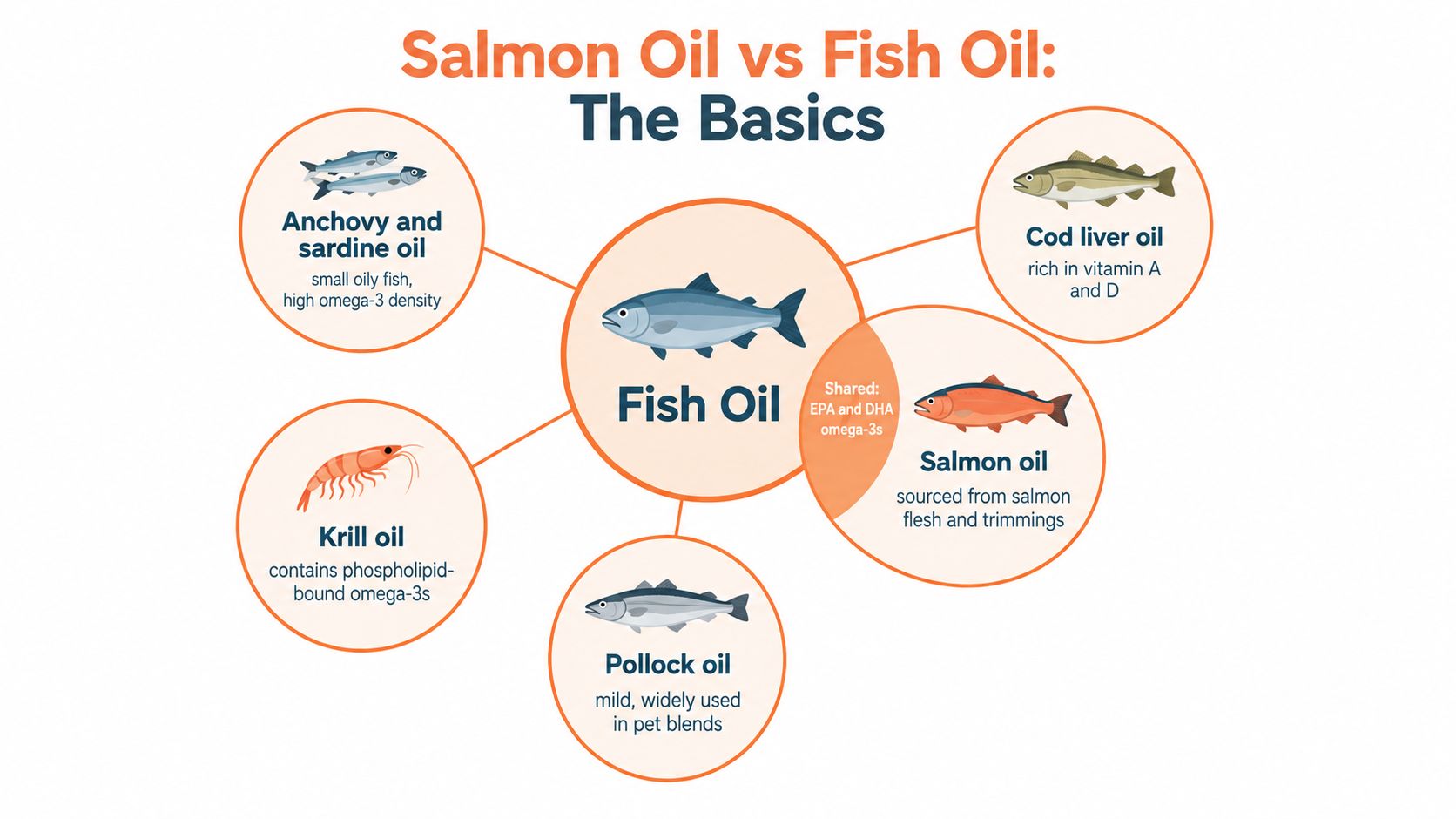
Fish oil means oil extracted from fish tissue. The category can include anchovy, sardine, mackerel, pollock, tuna, salmon, and other marine species. Some products use one source, while others blend oils or concentrate them after extraction.
Salmon oil is fish oil sourced specifically from salmon. Its fatty-acid profile can differ from the broader marine-oil category. In a 2018 comparative analysis, marine fish oils generally contained about 20–30% omega-3 polyunsaturated fatty acids, with EPA and DHA together representing more than 80% of those omega-3s. Salmon oil had the highest EPA proportion among the examined oils at 17.00%, while tuna oil had the highest DHA proportion at 21.94%. The same analysis found approximately 28 mol% of salmon oil's EPA and 57 mol% of its DHA in the triglyceride sn-2 position. See the comparative analysis of salmon and marine fish oils for the underlying composition data.
The two numbers that matter most
EPA, or eicosapentaenoic acid, and DHA, or docosahexaenoic acid, are the principal marine omega-3 fatty acids used when canine supplements are evaluated. They share the same broad category but aren't interchangeable in every biological role, so a clear label should identify both separately.
The chemical form matters too. Natural marine oils commonly place EPA and DHA within triglyceride molecules. Processing can change that structure, and the form may affect digestion and absorption. Don't overcomplicate your first purchase, though. The practical order is simple: confirm the actual EPA and DHA amounts, identify the chemical form if disclosed, then evaluate testing and tolerability.
Why “omega-3” is an incomplete answer
A label that says “1,000 mg fish oil” doesn't tell you that it contains 1,000 mg of EPA and DHA. The total oil includes other fats. A label that says “omega-3 blend” is also incomplete unless it states how much EPA and DHA are present in the serving.
For canine use, record three figures before comparing products:
- EPA per serving
- DHA per serving
- EPA plus DHA per kilogram of body weight
That calculation turns a marketing category into a dosing comparison.
Side-by-Side Comparison of the Two Oils
The phrase “salmon oil vs fish oil” sounds like a head-to-head ingredient contest. In practice, it's a comparison between a named species and a broad category. The product's declared potency and testing determine where it belongs.
Salmon oil vs fish oil at a glance
| Criterion | Salmon oil | Generic fish oil |
|---|---|---|
| Source | Salmon flesh, trimmings, or other salmon-derived material | One or more marine fish species, such as pollock, anchovy, sardine, tuna, or salmon |
| EPA and DHA | Present, with proportions that vary by source and processing | Present, with proportions that vary by species, blend, and concentration |
| Omega-3 concentration | Can be moderate or concentrated | Can be moderate or highly concentrated |
| EPA-to-DHA balance | Species-specific, but not fixed across products | Product-specific and often different between blends |
| Chemical form | May be natural triglyceride or further processed | May be triglyceride, re-esterified triglyceride, ethyl ester, or another disclosed form |
| Palatability | Often attractive to dogs, though smell and acceptance vary | Varies widely by source, freshness, flavoring, and oxidation |
| Quality signal | Clear species identity | Transparent blend and batch documentation |
| Best comparison point | EPA plus DHA per serving, not “salmon” alone | EPA plus DHA per serving, not total fish-oil volume |
Source species is real, but it isn't a score
Salmon oil gives you a defined source. That can help owners who want to know exactly which fish supplied the oil. Generic fish oil gives you a wider category and may use smaller oily fish or a blend chosen for potency, availability, sustainability, or processing efficiency.
Neither label wins automatically. A salmon-only product with vague testing is a weaker choice than a clearly documented blend with verified EPA and DHA. Conversely, a generic fish oil that hides its source and provides only total oil leaves you with too little information to dose confidently.
Concentration changes the serving
A low-concentration salmon oil may need more liquid to deliver the same EPA plus DHA as a concentrated fish oil. That affects cost per useful dose, calories, bowl acceptance, and the risk of accidentally adding more fat than intended.
Ask the brand for the EPA-plus-DHA amount per pump or teaspoon, not just the fish-oil amount. If the answer isn't printed on the label or available in batch documentation, move on.
Sourcing, Purity, and Oxidation
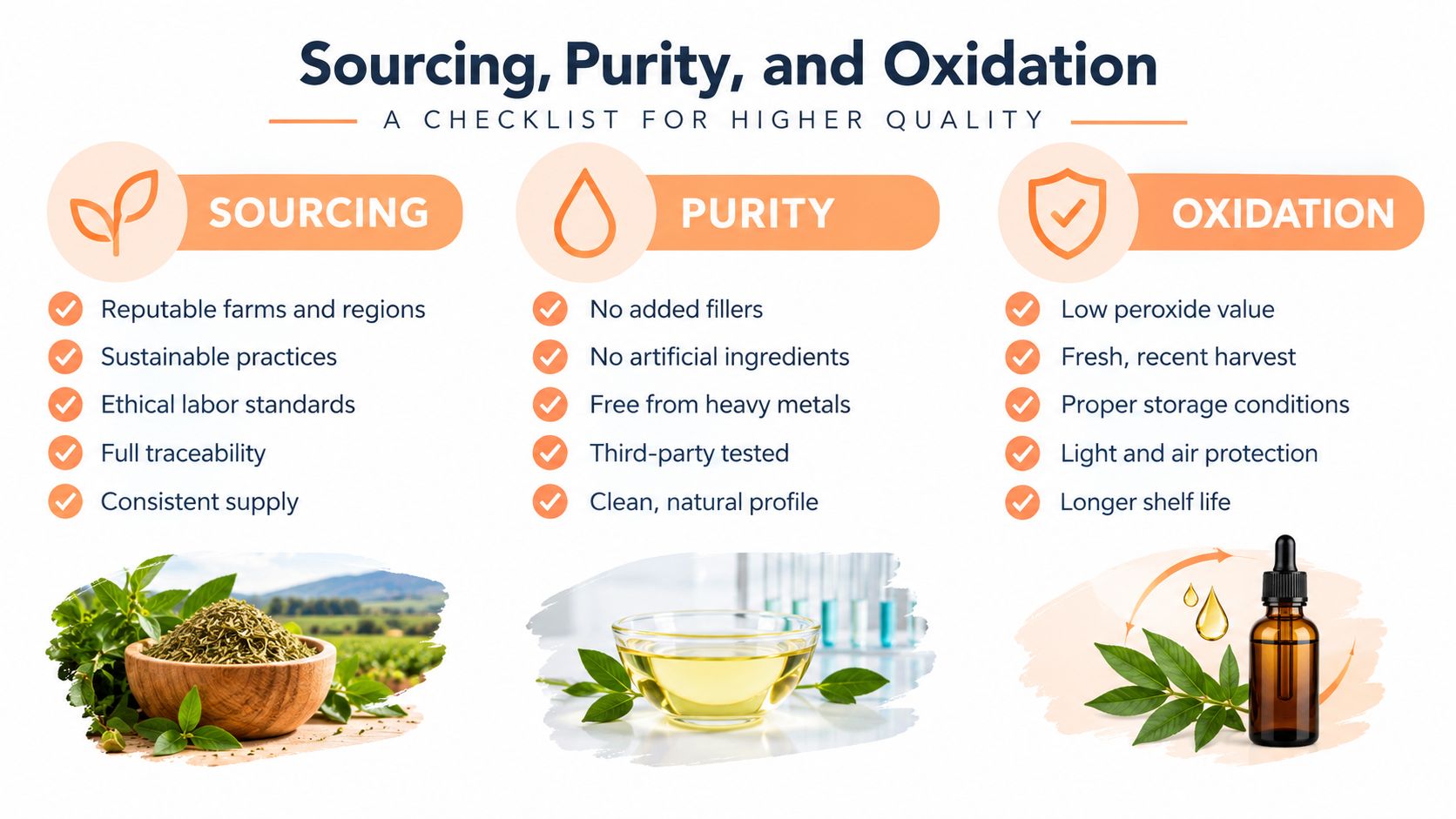
A salmon label doesn't guarantee purity. Wild salmon, farmed salmon, anchovy oil, sardine oil, and pollock oil all need appropriate handling and testing. Feed history, source tissue, extraction, concentration, storage, and packaging can change the final oil.
Research on salmon-derived oil demonstrates how variable the raw material can be. In one randomized feeding study, farmed salmon fed mainly fish oil contained 2.1 g of EPA plus DHA per 100 g of fillet, compared with 0.9 g per 100 g when the feed relied mainly on rapeseed oil. Separate work on salmon-processing by-product oil measured 13.54% total omega-3 polyunsaturated fatty acids in the starting oil, while one concentration method raised omega-3 content to 52.96% and achieved 86.17% EPA-plus-DHA recovery. Those figures come from the research on feed, salmon tissue, and processing effects.
Oxidation is the quality failure owners can smell
EPA and DHA contain multiple double bonds, which makes them vulnerable to oxygen, heat, and light. Oxidation can reduce intact fatty acids and create primary and secondary oxidation products. A rancid smell is a warning sign, but smell alone isn't a laboratory test.
Ask whether the brand measures:
- Peroxide value, which tracks primary oxidation.
- Anisidine value, which tracks secondary oxidation.
- TOTOX, which combines oxidation indicators.
Voluntary GOED benchmarks commonly cited for marine-oil quality control include peroxide value no higher than 5 mEq/kg, anisidine value no higher than 20, and TOTOX no higher than 26. Those benchmarks and contaminant considerations are discussed in this review of fish-oil quality and oxidation.
Purity requires a document, not a promise
A Certificate of Analysis should connect a batch number to EPA and DHA assay results, oxidation values, and contaminant screening. Relevant contaminants include mercury, PCBs, dioxins, and furans. The same quality review cites a mercury benchmark below 0.1 mg/kg, along with specified limits for dioxins, furans, and PCBs.
Wild-caught sourcing can support a sustainability preference, but “wild” isn't a substitute for purification or testing. Read the details in PetScy's overview of fish oil from sustainable wild-caught fisheries, then ask any brand for batch-level evidence.
Best Use Cases for Dogs
Fish-derived EPA and DHA can support several canine goals, but the evidence usually applies to marine omega-3 supplementation broadly. It doesn't prove that salmon oil beats pollock, sardine, anchovy, or another tested source.
Skin, coat, and itching
EPA and DHA are commonly considered for dogs with pruritus, coat changes, and inflammatory skin conditions. A controlled study reported that fish oil significantly improved pruritus, alopecia, and coat character compared with placebo, but that result supports fish oil generally. It doesn't establish salmon oil as the superior source. The canine dermatology study is the relevant evidence.
Use omega-3s as supportive care, not as a substitute for finding the cause. Fleas, bacterial or yeast infection, food allergy, and environmental allergy can all produce itching. If your dog is chewing paws, developing ear problems, or losing hair, get the primary issue assessed.
Joint comfort and mobility
For a stiff or aging dog, compare products by delivered EPA plus DHA and follow veterinary dosing guidance. A more concentrated product may fit better when adding a large volume of oil would upset the dog's diet or cause refusal.
Don't choose salmon solely because it sounds more natural. Choose the oil that gives you a clear dose, reliable testing, and a format your dog will take consistently.
Cognitive and reproductive contexts
DHA is relevant to neurological tissues, but a supplement label shouldn't promise cognitive restoration. Use a veterinary plan for senior dogs with behavioral or mobility changes, since pain, sensory loss, endocrine disease, and cognitive dysfunction can overlap.
A salmon-oil study in nine dogs used 180 mg of DHA per 7 kg of body weight daily for 90 days and reported improved motility, membrane integrity, and viability in frozen-thawed semen samples. That is a reproductive endpoint, not proof of superior outcomes for allergies, joints, or cognition. The study and dosing context appear in this veterinary review of canine EPA and DHA use.
Dose is a calculation, not a guess
The National Research Council safe upper limit cited in veterinary guidance is 280 mg of total EPA plus DHA per 100 kcal, while reported therapeutic DHA supplementation ranges from 50–220 mg/kg body weight. Those figures are not a reason to self-prescribe a therapeutic dose. They show why a veterinarian should account for body weight, calories, medical history, diet, and the purpose of supplementation.
This video provides additional context for owners comparing canine omega-3 options:
When Fish Oil Is the Wrong Choice
Fish oil isn't automatically appropriate for every dog. The first problem is often not the source species, but the added fat, calories, dose, or interaction with an existing condition.
Veterinary guidance recommends caution for dogs with pancreatitis, diarrhea, clotting disorders, diabetes, or anticoagulant use. A dog with a history of pancreatitis may not tolerate an oily supplement well. A dog taking anticoagulant medication may need a veterinarian to review the total bleeding-risk picture before receiving concentrated EPA and DHA.
Stop treating the supplement as harmless by default
Oily liquids add fat and calories to the daily ration. That matters for overweight dogs, dogs on calorie-controlled diets, and dogs whose gastrointestinal signs worsen when the diet becomes richer. If loose stool or vomiting begins after introduction, stop the product and speak with your veterinarian rather than switching immediately to another fish oil.
A product can also be inappropriate because it's unreliable. Missing EPA and DHA declarations, no batch testing, poor storage, or a rancid odor should disqualify it. “Natural salmon oil” doesn't excuse a weak quality file.
A lower-volume, properly tested product may be easier to manage than a large serving of low-strength oil.
Consider another format
Some dogs reject liquid oil, while others accept a measured chew or capsule more readily. A different format can help control the serving, but only if the label still states the actual EPA and DHA content. A flavored product with an attractive front label and no fatty-acid breakdown isn't an upgrade.
Pause supplementation while your veterinarian investigates persistent diarrhea, recurrent skin infection, unexplained bruising, or suspected food allergy. Omega-3s can complement treatment, but they can't replace diagnosis.
Which Oil to Choose for Your Dog
My default recommendation is straightforward: choose a wild-caught, third-party-tested omega-3 product with explicit EPA and DHA amounts, regardless of whether the front label says salmon.
That recommendation branches according to the dog and the owner.
For picky eaters
Start with freshness and dose accuracy. Dogs often notice oxidized oil, strong odor, or a sudden large serving. Introduce the product with food, use the measured pump or teaspoon, and adjust only under veterinary guidance. If your dog refuses a liquid, compare a capsule or chew by EPA plus DHA rather than by flavor claims.
For small and large dogs
Small dogs need especially careful label reading because a full pump may be a large serving relative to body weight. Large dogs may need a concentrated product to avoid adding an impractical amount of oil to the bowl.
Write down your dog's body weight and calculate the delivered EPA plus DHA before buying. Don't compare a bottle's total milliliters with another bottle's total milligrams. Those figures describe the container, not the dose your dog receives.
For sustainability-focused owners
Source transparency matters more than a salmon illustration. Ask whether the fishery is identified, whether the product uses processing by-products, and whether the manufacturer documents purity and traceability. Fish-processing waste oils can contribute to more circular sourcing, and a tested pollock or blended marine oil may be a sensible alternative to imported salmon oil.
For budget shoppers
Compare cost per delivered EPA-plus-DHA dose, not cost per bottle. A cheaper, dilute oil may require more liquid and run out sooner. A more expensive bottle may still be poor value if the brand doesn't disclose fatty-acid amounts or test oxidation.
PetScy offers a fish oil made with wild-caught Alaskan pollock and salmon oils, with EPA and DHA identified for pets. It's one option to compare against other products using the same label checklist.
Buying and Storage Tips That Protect the Dose
Use this checklist before placing an order:
- Read the Supplement Facts panel: Find EPA and DHA separately, then add them to calculate total EPA plus DHA per serving.
- Check the serving unit: Confirm whether the dose is measured per pump, teaspoon, capsule, chew, or milliliter.
- Request testing: Look for oxidation results, contaminant screening, lot identification, and a Certificate of Analysis.
- Inspect the container: Dark packaging, oxygen-limiting pumps, and oxygen-reduction methods help protect marine oil from light and air.
- Check the smell: A sharp rancid or paint-like odor is a reason not to use the oil.
- Follow storage instructions: Keep the bottle away from heat and direct sunlight. Refrigerate only when the manufacturer recommends it, because some pumps and liquids may behave differently when chilled.
The PetScy guide to choosing fish oil for dogs can help you compare the practical label details without treating salmon as an automatic quality mark.
Three quick answers
How long until results show? Skin, coat, and mobility changes aren't instant. Track the original problem and follow up with your veterinarian if there's no meaningful improvement or if signs worsen.
Should I give fish oil with food? Giving it with a meal is usually the most practical approach for tolerance and routine, unless your veterinarian or the product label says otherwise.
Should I refrigerate it? Follow the product's storage directions. Protecting the oil from heat, light, and air matters more than choosing salmon over generic fish oil.
PetScy offers a veterinarian-formulated fish oil using wild-caught Alaskan pollock and salmon sources, with EPA and DHA disclosed for pet use. Compare its serving information and quality details with the checklist above, then visit PetScy to choose an omega-3 option that fits your dog's needs and your veterinarian's plan.