









Dog Water Additive Breath Guide That Actually Works
You fill your dog's bowl, add the recommended dental liquid, and hope the next morning brings fresher breath. Yet your dog yawns beside you, and the odor is still there. That experience is common because dog water additive breath care works on a limited part of the problem. It can support cleaner tooth surfaces and reduce odor compounds, but it can't remove disease hidden under the gums.
The most useful way to judge a product is to ask three questions: What is causing the smell? Where can the additive reach? What else does your dog need? The answers will help you use a water additive as a practical daily tool instead of treating it as a cure.
Table of Contents
- Why Your Dogs Breath Still Smells Despite Daily Care
- What Causes Bad Breath and Why It Is So Common in Dogs
- How Dog Water Additives Work Inside the Mouth
- Key Ingredients and What Evidence Shows About Effectiveness
- How to Use a Water Additive Correctly and Get Consistent Results
- Water Additives Compared to Dental Powder Wipes and Chews
- Choosing a Safe Vet Formulated Product and When to See the Vet
Why Your Dogs Breath Still Smells Despite Daily Care
Mabel receives dental treats, chews, and a water additive every day. Her bowl is treated as directed, yet the odor returns soon after drinking. That pattern can make an owner question the product, but breath often reflects the mouth's condition rather than a temporary coating on the tongue.
Plaque and food debris gather around teeth, especially near the gumline. Irritated gums, trapped material, or a damaged tooth can continue producing odor after a freshener has made exposed surfaces smell cleaner. A useful review of hidden causes of halitosis helps broaden the search beyond the last meal.
Mabel also resists tooth brushing. Her additive may reach the water-washed, above-the-gumline surfaces, while plaque or inflammation remains in areas the liquid cannot clean. Water additives work as an adjunct, much like rinsing a dirty cup after the residue has dried. They can support daily care, but they do not remove established tartar or treat disease beneath the gums.
Practical rule: A fresher smell is useful feedback, but it isn't proof that the mouth is disease-free.
Start with the symptom, not the bottle
Recurring halitosis deserves attention because it can accompany periodontal disease. In an analysis of 12,753 dogs with assigned periodontal status, overall periodontal disease prevalence was 50.5%. Dogs with halitosis had higher odds of disease, with an odds ratio of 2.03 and a 95% confidence interval of 1.75 to 2.34 (Journal of Small Animal Practice evidence).
These findings do not diagnose Mabel, or any individual dog, with advanced disease. They do give owners a sensible triage point: recurring odor warrants a mouth check and may warrant veterinary assessment, particularly with red gums, visible tartar, chewing difficulty, or reduced appetite.
Use the additive for the job it can handle, then check whether the rest of the routine addresses plaque. Guidance on bad breath, tartar, and daily care can help owners build consistent care instead of chasing odor alone.
What Causes Bad Breath and Why It Is So Common in Dogs
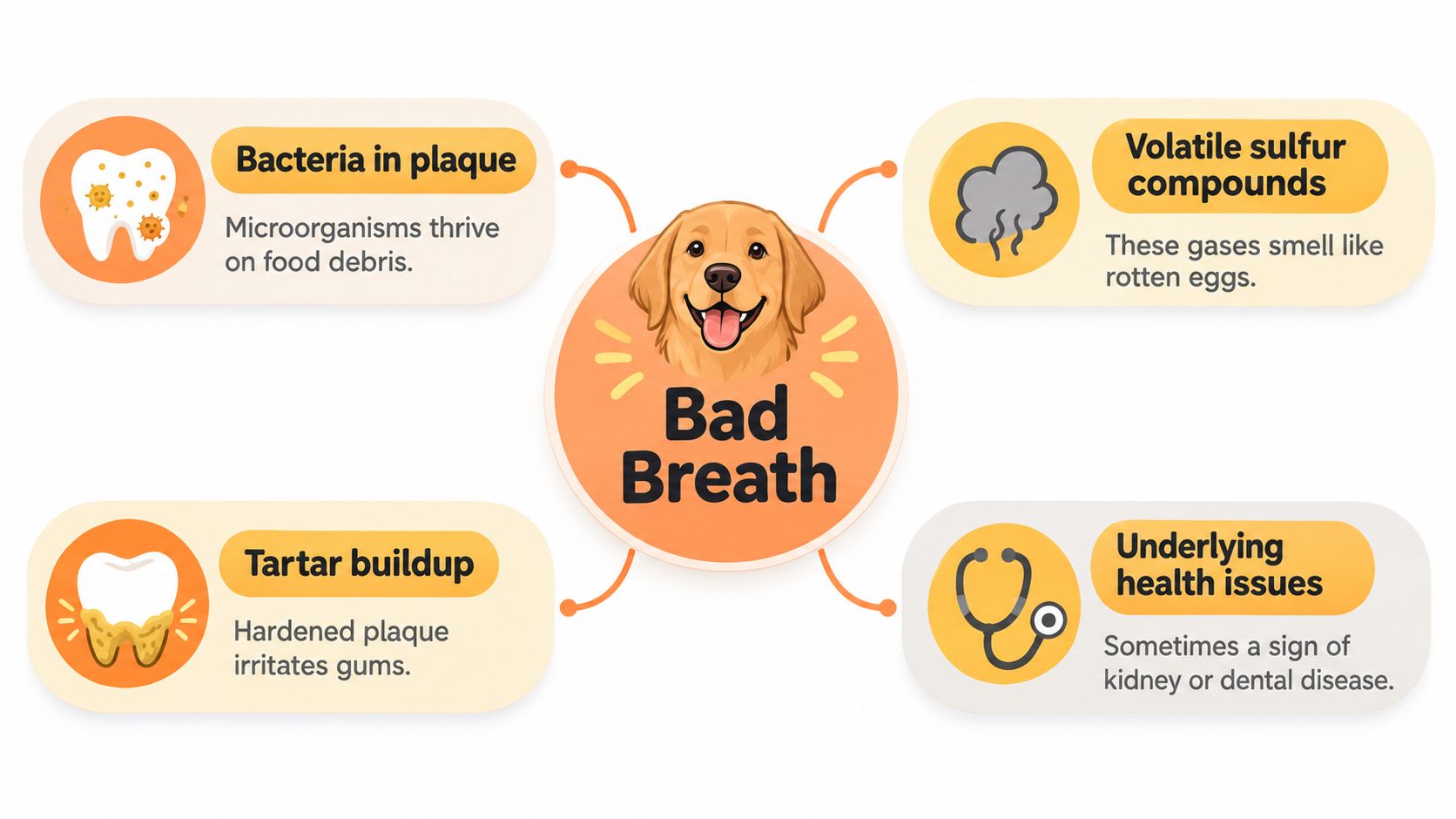
A dog may finish dinner, drink from a water bowl, and still develop a strong smell because the source is often attached to the teeth. Plaque is a sticky bacterial film that forms on tooth surfaces. It works like a thin, damp neighborhood where microorganisms settle, use food residue, and release waste products. Some of those products are volatile sulfur compounds, or VSCs, which can smell rotten or sulfur-like.
If plaque stays in place, minerals can harden it into tartar, also called calculus. This rough deposit gives new plaque more surface to cling to and can press along the gumline. Gums may then become irritated, swollen, or prone to bleeding. Bacteria, inflammation, and trapped debris can reinforce one another, making the odor stronger.
Why prevalence changes the buying decision
Periodontal disease is among the most common oral diseases in dogs. Reported prevalence ranges from 44% to 80%, depending on age and study design, and some reports indicate that over 80% of dogs show signs by age 3 (veterinary evidence review).
These figures cannot diagnose one dog, nor do they show that an additive will prevent disease. They do explain why “fresh breath” should not be the only buying criterion. Many dogs with odor may also need gumline care, a dental examination, or treatment that a liquid cannot provide.
The odor chain in plain language
The process follows a simple sequence:
- Bacteria settle in plaque. Food particles and saliva help form a film on the teeth.
- The bacterial community produces odor compounds. VSCs are among the compounds associated with halitosis.
- Plaque hardens into tartar. The rough deposit makes further buildup easier.
- Gum inflammation develops. Irritated tissue may add to the odor and can signal periodontal disease.
A water additive can support surfaces above the gumline, but it cannot remove established tartar or repair diseased tissue below it. Diet may affect chewing, food residue, and daily habits, yet persistent odor still calls for dental assessment. Owners seeking practical diet tips for fresh dog breath should treat food changes as supportive, not curative.
How Dog Water Additives Work Inside the Mouth
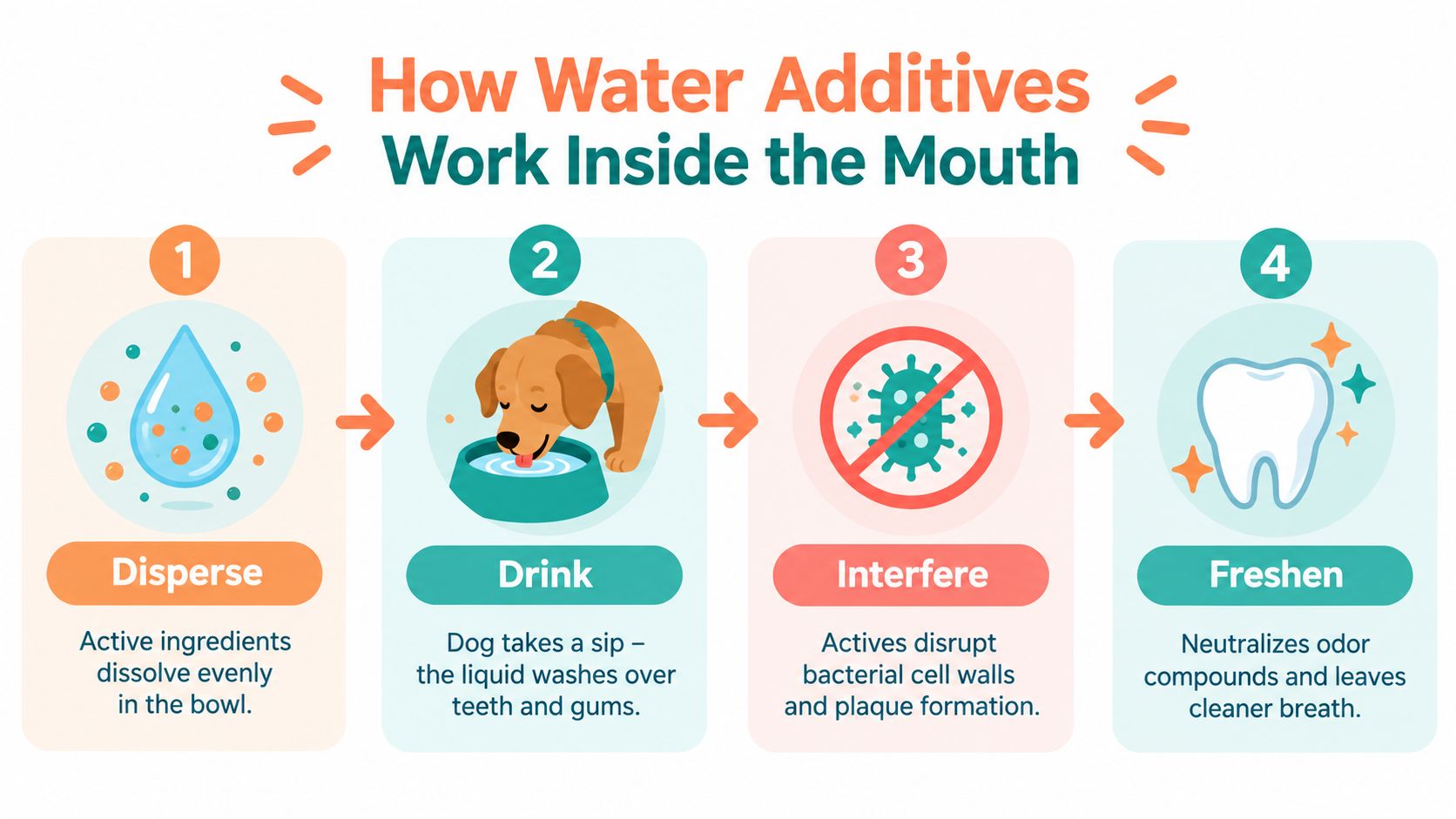
A water additive acts like a chemical support layer for daily oral care. You mix the product into drinking water according to its label. Each time your dog drinks, the treated liquid passes across parts of the tongue, teeth, and gumline. The active ingredients may interfere with plaque formation, reduce certain bacteria, or affect odor compounds on exposed surfaces.
That process depends on contact. A dog that drinks consistently receives more opportunities for the formula to pass through the mouth than a dog that avoids the bowl because of taste. An additive also can't scrub the way a toothbrush, textured wipe, or suitable chew can. Its benefit comes from repeated exposure, not from one dramatic dose.
What the liquid can reach
Water additives are designed to circulate through drinking water and contact oral surfaces above the gumline. That makes them most useful for daily maintenance, early plaque management, and odor support. They may also help owners who can't brush reliably because their dog dislikes mouth handling.
The anatomical boundary matters more than the marketing language. Additives don't clean subgingival areas, the pockets beneath the gumline where periodontal disease commonly begins (technical explanation of dog dental water additives). A liquid can wash over the visible crown of a tooth without treating infection, deep calculus, damaged roots, or bone loss below the gumline.
Water additives are best understood as an adjunct, not a replacement for mechanical plaque control or veterinary dental treatment.
Use the product alongside brushing, finger wipes, or other veterinarian-approved measures when your dog accepts them. If the mouth already has advanced tartar or painful gums, adding liquid to the bowl won't reverse that condition. The appropriate next step is an examination and a care plan.
Key Ingredients and What Evidence Shows About Effectiveness
A dog may drink treated water every day and still develop strong breath if plaque has already hardened or disease sits below the gumline. The formula's job is narrower. Most ingredients aim to slow plaque formation, limit calculus accumulation, or reduce odor compounds on exposed oral surfaces. Judge the finished product by what it has been tested to measure, not by whether an ingredient sounds natural or powerful.
A 30-day study examined a pomegranate-based water additive after professional cleaning. Dogs receiving the additive had significantly lower plaque and calculus indices than the control group. One calculus measure fell from 0.33 to 0.00, described as a 100% reduction, compared with a 51% reduction in controls. The additive group also showed a greater mean reduction in plaque-related indices, 0.32 versus 0.14, with p = 0.016 (peer-reviewed canine water-additive study).
Those findings show that a tested formula can produce measurable short-term changes. They do not establish that every water additive works the same way, or that liquid can remove established tartar. The study followed professional cleaning, so its results differ from treating an untreated mouth with visible calculus or painful gums.
Match the ingredient category to the target
| Ingredient type | Primary action | Evidence signal |
|---|---|---|
| Botanical plaque-support ingredients | Help interfere with plaque accumulation on exposed tooth surfaces | A pomegranate-based additive produced lower plaque and calculus indices after 30 days in a controlled study |
| Anti-calculus oral-care actives | Help slow new calculus accumulation when consumed consistently | A randomized, double-blind 208-day pilot trial found that a xylitol-based drinking water additive reduced plaque and calculus accumulation (trial report) |
| Odor-focused actives | Target compounds associated with halitosis | Earlier oral-care trials measured lower breath VSCs by day 14 and day 27 in dogs consuming dental products compared with controls |
| Chlorine-dioxide and cetylpyridinium-style treatments | Affect oral bacteria and odor chemistry | A published dog study reported reduced VSCs, while its authors called for longer-term safety and durability data (halitosis treatment study) |
Read the label like a routine designer
A useful label states the amount for a specified water volume, the species that can use the product, and relevant precautions. It should also explain whether the formula targets plaque, tartar, breath, or more than one concern. These details help you match the product to the problem rather than expecting one liquid to replace brushing or veterinary care.
Consistency affects exposure. The longer-term xylitol-based pilot supports using a product regularly, while sporadic dosing provides sporadic contact with the mouth. Choose a palatable formula your dog will drink as directed. If you are comparing options, review this guide to the best dental water additive for dogs alongside your dog's existing dental routine.
How to Use a Water Additive Correctly and Get Consistent Results
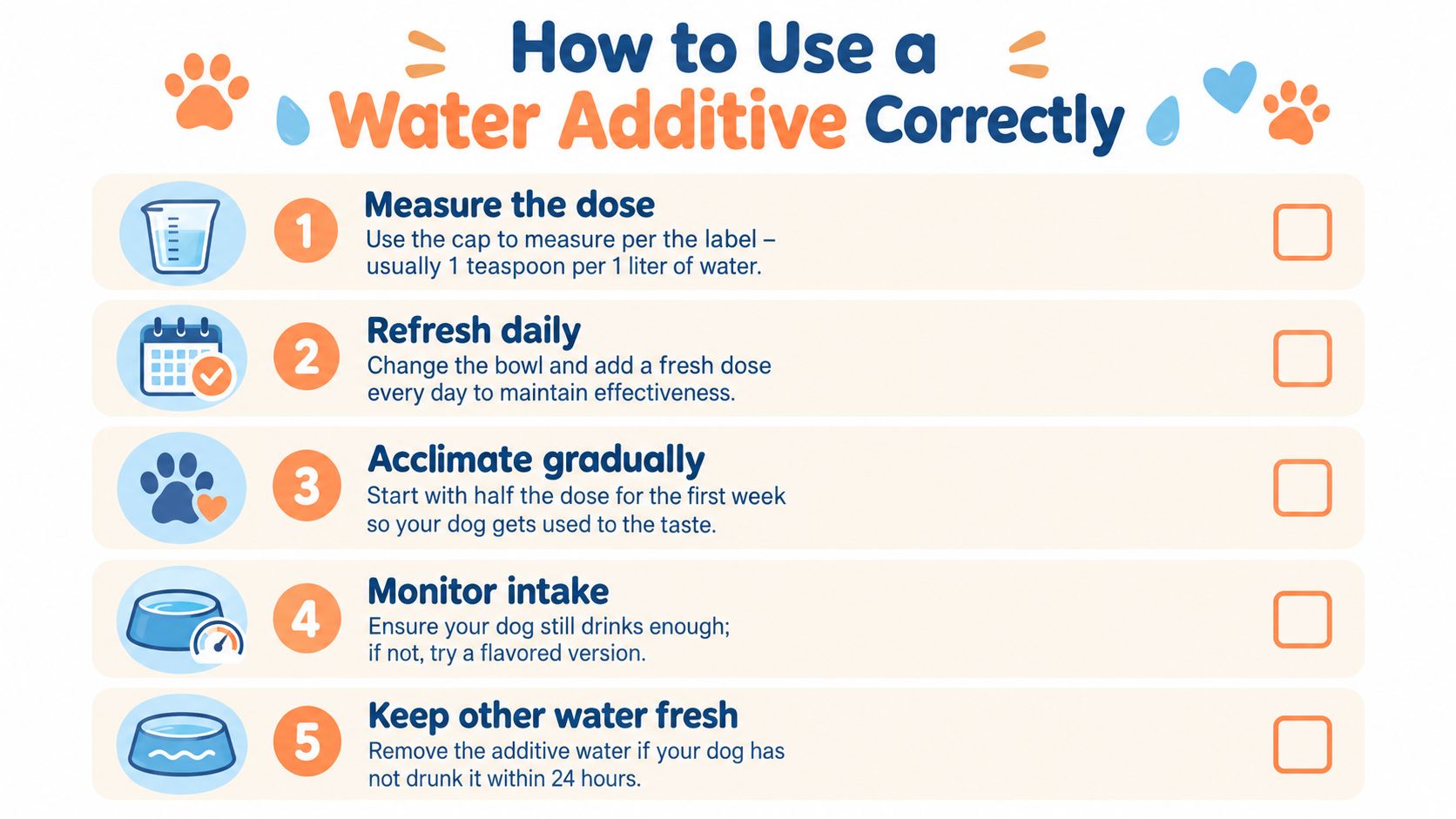
Correct use begins with the product label, not a guessed capful. Measure the stated amount for the stated water volume, use fresh drinking water, and don't increase the dose because the breath is especially strong. More product isn't automatically more effective, and a concentrated taste may cause a dog to drink less.
Refresh the bowl on the schedule the label gives. A clean bowl and a fresh mixture make it easier to control what your dog consumes. If several pets share the bowl, check that every animal can tolerate the formula and that the treated water isn't replacing normal hydration.
Build acceptance before judging results
A dog may reject a changed taste even when the formula is safe. Introduce the product gradually according to its directions, and watch the bowl rather than assuming your dog is drinking normally. If intake drops, remove the treated water and offer plain water while you reassess the product with your veterinarian.
A practical routine looks like this:
- Measure carefully. Use the supplied cap or a measuring tool only when the product instructions specify it.
- Refresh consistently. Wash the bowl and prepare a new mixture as directed.
- Watch drinking behavior. Normal hydration comes before dental convenience.
- Pair with direct care. Brush or use a dental wipe when your dog tolerates mouth handling.
- Track the pattern. Note whether odor improves, stays unchanged, or returns quickly.
Hydration comes first: A product that makes your dog avoid water isn't suitable for that dog, regardless of its dental claims.
A water additive can support above-gumline maintenance, but it won't make a painful mouth comfortable enough for every dog to drink normally. If your dog refuses water, drools, paws at the mouth, or struggles to eat, stop treating the issue as a breath problem and seek veterinary guidance.
Water Additives Compared to Dental Powder Wipes and Chews
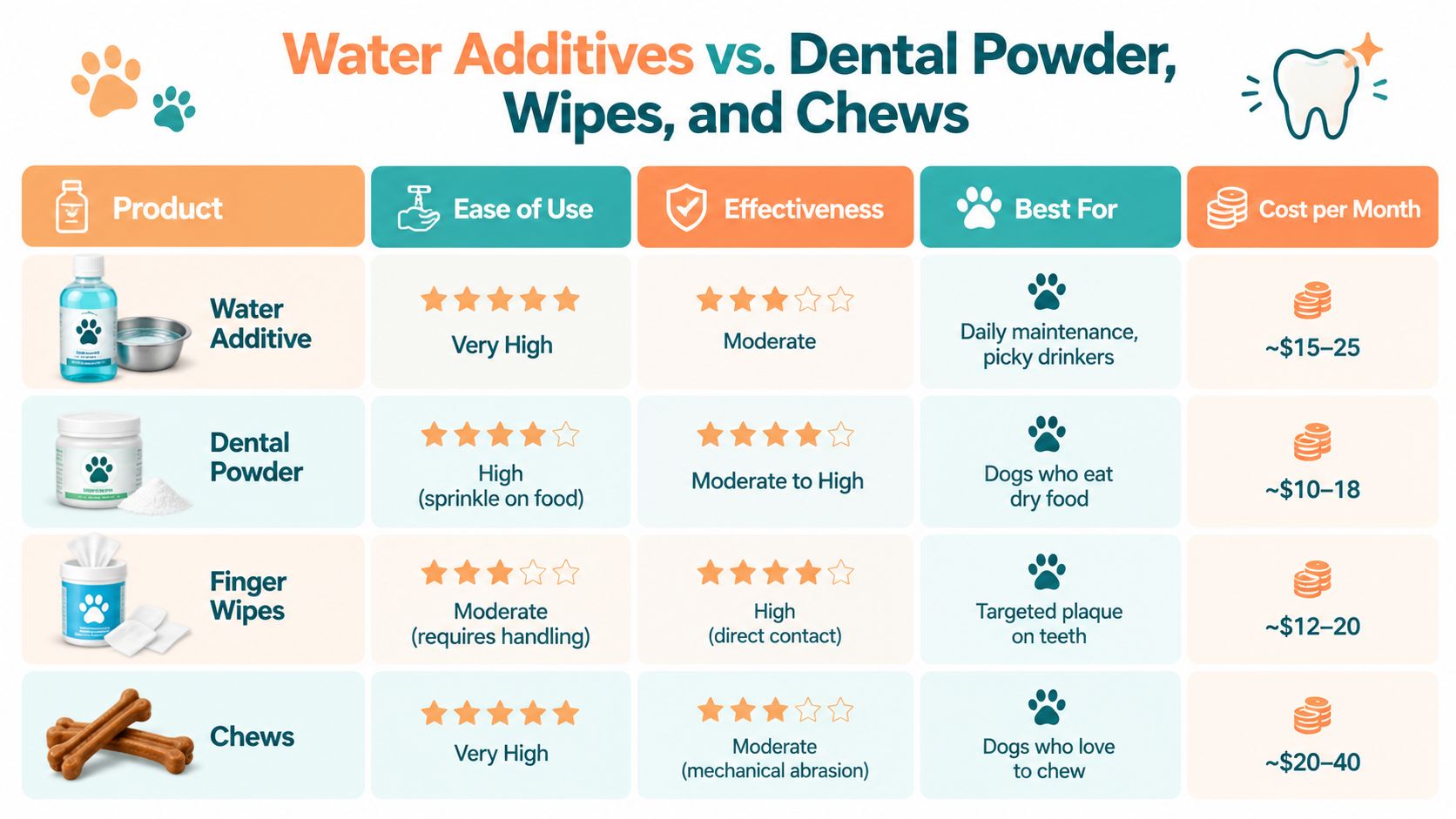
The right dental format depends on what your dog will accept and which surfaces you can reach. A water additive requires little handling, so it suits dogs that resist brushing. Its limitation is passive coverage. The liquid reaches exposed areas, but it doesn't create the same friction as a wipe or toothbrush.
Dental powder mixes with food and can be easier than direct mouth care for some households. It still depends on the dog eating the complete meal, and it doesn't provide the owner with precise contact against a particular tooth. Finger wipes offer more direct control. You can target the outer tooth surfaces and the gumline, though the method requires a dog that tolerates handling.
Choose by temperament and coverage
| Format | Main advantage | Main limitation | Good fit |
|---|---|---|---|
| Water additive | Minimal handling and easy daily repetition | Doesn't reach below the gumline or scrub deposits | Dogs that dislike mouth handling |
| Dental powder | Simple to mix with food | Depends on complete meal consumption | Dogs that reliably eat meals |
| Finger wipes | Direct contact with accessible tooth surfaces | Requires cooperation and steady handling | Dogs who tolerate gentle mouth care |
| Chews | Offers chewing activity and mechanical contact | Coverage varies with chewing style and product shape | Dogs that enjoy appropriate chewing |
A combination can make sense when each format fills a different gap. For example, an additive can provide passive daily support while a wipe handles visible surface debris. That still doesn't turn home care into treatment for established periodontal disease.
Owners considering a food-based option can review dog dental powder and compare it with their dog's eating habits. The best routine is the one that protects hydration, fits the dog's tolerance, and can be repeated without creating a daily struggle.
Choosing a Safe Vet Formulated Product and When to See the Vet
Select a product with a clear species label, transparent ingredients, precise dosing directions, and usage instructions that match your household. Vet-formulated positioning can be useful, but it shouldn't replace your own review of the label. Look for quality signals such as NASC membership, United States manufacturing claims, ingredient traceability, and third-party testing information when those details are available.
Avoid products with unclear dosing or claims that imply a liquid can cure periodontal disease. Be cautious with formulas that rely mainly on strong masking flavors without explaining their oral-care purpose. Palatability matters because a dog must keep drinking the treated water, and any reduction in hydration is a reason to stop and reassess.
A veterinary visit is more important than product selection when your dog has persistent odor with red or bleeding gums, visible tartar, a broken or discolored tooth, trouble chewing, drooling, mouth pain, or reduced appetite. These signs may point to gingivitis, infection, or disease below the gumline. A water additive can support maintenance after assessment, but it can't clean a periodontal pocket or repair a damaged tooth.
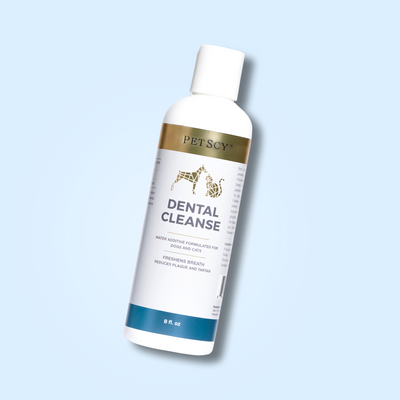
PetScy's Dental Cleanse is one water-based option described for daily dog dental care, while the same catalog also includes dental powder and finger wipes for owners who need different forms of contact. Choose based on your dog's drinking habits, tolerance, and veterinary advice rather than treating any single format as a complete dental plan.
Build a repeatable routine with PetScy's veterinarian-formulated dental options, including Dental Cleanse, powder, and finger wipes, and choose the format your dog will accept consistently. Visit PetScy to review the products and create a practical plan for fresher breath and ongoing oral hygiene.