














Should Dogs Take Probiotics Daily? Vet-Based Guide
Healthy dogs don't automatically need probiotics every day indefinitely, and daily use only makes sense for a specific dog, strain, dose, and reason that you reassess with a veterinarian. That's the opposite of the popular advice that treats a probiotic chew like a daily vitamin every healthy dog is missing. If your dog eats well, holds weight, and passes normal stool, you don't have a problem to fix, and adding live microbes on a forever schedule is a habit in search of a purpose.
Table of Contents
- Should Dogs Take Probiotics Daily
- How a Dog Probiotic Supports the Gut
- Dogs That May Benefit from Daily Use
- What Studies Show About Everyday Use
- How to Choose a Daily Dog Probiotic
- How Long a Daily Probiotic Should Last
- Your Next Step After the Trial
Should Dogs Take Probiotics Daily
The honest answer to should dogs take probiotics daily isn't yes or no for the whole species. It's only if you can name the job. A probiotic is better thought of as a spare key than a daily vitamin. You keep a spare key because there's a known moment when you might need it. You don't carry five of them forever just in case.
That distinction matters because veterinary literature indicates effects are highly strain-specific, condition-specific, and individual-specific. The American Veterinary Medical Association review of probiotics in dogs and cats notes that probiotics can alter intestinal microbial populations, fecal short-chain-fatty-acid profiles, and some immune measures, but consistent clinical benefits in healthy dogs or dogs with chronic gastrointestinal disease haven't been established.
Start With a Named Goal
Don't buy a recurring supply until you can finish this sentence in plain language, "I'm giving this because I want to see X change." Useful goals are narrow and observable.
- Firmer stool during boarding: A predictable stressor is coming and you want support through it, then a check afterward.
- Support during antibiotics: Your veterinarian is treating something and wants a plan for the gut while the medication runs.
- A short bout of unexplained diarrhea: The strongest evidence sits with selected acute cases, particularly stress-associated diarrhea, not with vague prevention.
- A diet transition: You're changing food and watching whether stool stays consistent through the switch.
"We want better overall wellness" isn't a goal you can measure. Neither is a promise about immunity, allergies, or longevity from a probiotic alone. If you can't describe what success looks like, you can't tell whether month three is helping or just billing you.
Practical rule: No named goal, no daily probiotic. Name the outcome first, then decide if a product fits it.
Who Should Skip the Forever Habit
A comfortable adult dog with normal appetite, steady weight, and normal stool doesn't need a daily chew to stay that way. You're not correcting a deficiency. Probiotics aren't nutrients your dog's food failed to provide, and framing them as a universal requirement oversells what the evidence supports.
That doesn't make them useless. It makes them targeted. The right question isn't whether probiotics are good or bad as a category. It's whether this strain, at this dose, in this dog, for this reason, is worth a monitored trial. Before you start, it's worth reading whether probiotics are safe for dogs so you know which dogs need extra caution and which signs mean you stop and call the clinic instead.
The sections ahead sort that out in order. You'll look at how a probiotic works in the gut, which dogs are reasonable candidates, what the studies do and don't show, how to read a label without guessing, and how long a trial should run before you make a stop-or-continue call.
How a Dog Probiotic Supports the Gut
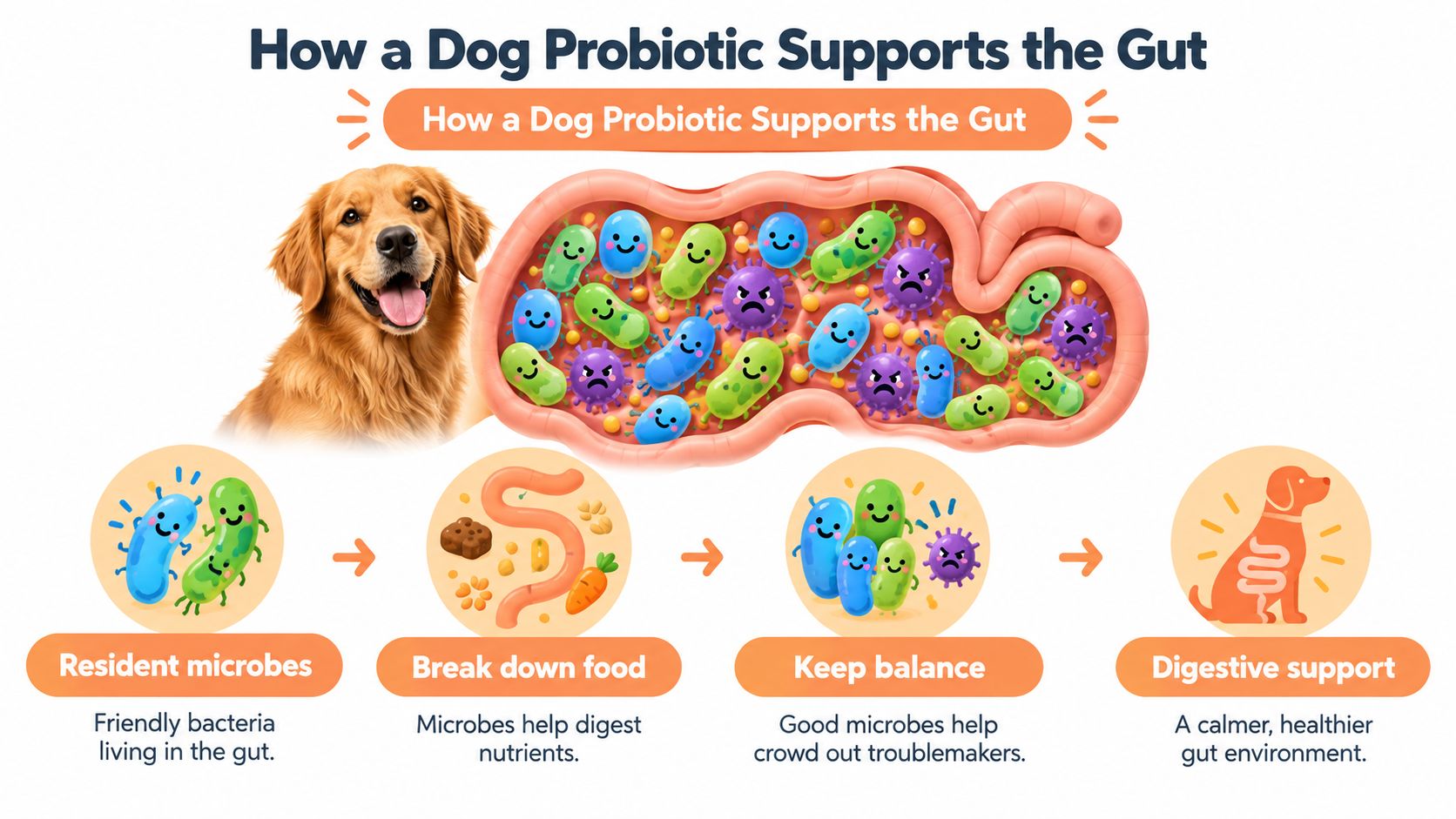
Think of your dog's gut as a crowded neighborhood. Resident microbes live there full time. They help break down food, produce useful byproducts from what your dog eats, and take up space and resources so less welcome organisms have a harder time moving in and multiplying. When that neighborhood stays balanced, digestion tends to run smoothly. When stress, illness, antibiotics, or a sudden diet change shakes it up, stool is often where you see it first.
The visual below maps that neighborhood idea so you can picture what a probiotic is being asked to do.
Three Words That Get Mixed Up
These terms sound interchangeable on a label. They aren't.
- Probiotic: Specific live microbes added to the gut. You're introducing new neighbors, and which neighbors they are matters enormously.
- Prebiotic: Food for microbes already there or added alongside. You're feeding the neighborhood rather than adding residents.
- Synbiotic: A combination of both, live microbes plus the fuel meant to help them do their job.
That last one matters later, because one of the clearest canine trials used a synbiotic, not a plain probiotic. Conflating the three is how owners end up assuming a result from one product type transfers to whatever's in their cart.
Why the Word Probiotic Predicts Almost Nothing
Here's the part most product pages gloss over. Different strains are different organisms with different behavior. Saying a chew "contains probiotics" tells you roughly as much as saying a neighborhood "contains people." It doesn't tell you who's moved in, whether they're suited to the place, or what they're likely to do.
That's why a human capsule from your own cabinet is a weak substitute, and why an unnamed proprietary blend is barely better. You can't match an unnamed organism to any evidence, because nothing was ever tested under that description.
Colony-forming units, or CFU, need the same skepticism. The CFU count describes how many viable organisms the label claims are in a dose. It's a quantity statement, not a clinical guarantee. More isn't automatically better, and a big number for the wrong strain doesn't beat a smaller number for a studied one.
Studied effects in dogs can include changes in microbial populations, fatty-acid profiles in feces, and some immune measures. Treat those as laboratory signals, not promised symptom relief. A shift in a measured value isn't the same thing as your dog feeling better, and honest guidance keeps those two ideas separate.
So before any product advice makes sense, you need four things from a label. Look for named strains, a stated viable dose, clear storage conditions, and an intended use that matches your dog's actual problem. If a label won't give you those, it hasn't earned a daily spot in your dog's routine.
Dogs That May Benefit from Daily Use
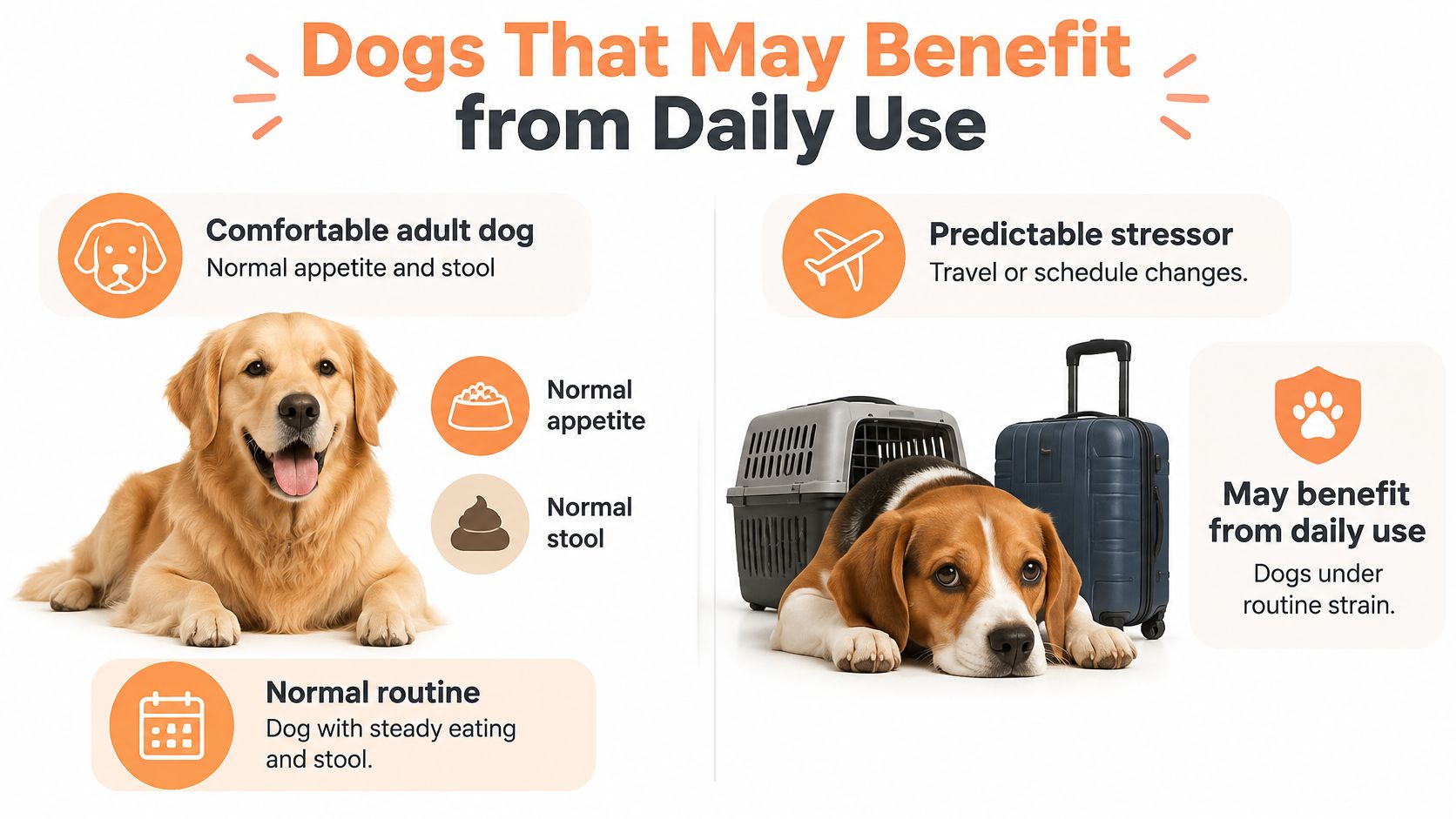
Start by picturing two dogs. The first is a settled adult who eats eagerly, keeps weight, and produces normal stool day after day. The second is about to be boarded for the first time, or just arrived in a shelter, or is two days into antibiotics with softening stool. Only one of them has a reason to discuss a probiotic. Sorting your dog into the right pile is most of the decision.
This comparison lays out that contrast between a dog on a normal routine and a dog facing a predictable stressor.
The Clearest Example Involves Stress
A 2017 randomized, placebo-controlled study tested a probiotic and prebiotic supplement in shelter dogs, where relocation and crowding create exactly the kind of stress that drives digestive problems. In that shelter synbiotic trial published through PubMed Central, dogs on the synbiotic had diarrhea on an average of 2.0% of scored days compared with 3.2% on placebo, a relative reduction of about 37.5%.
Within the first 14 days, diarrhea occurred in 18.8% of the synbiotic group versus 27.2% of the placebo group. More persistent diarrhea, at least two consecutive days, showed up in 4.6% of synbiotic dogs against 8.0% of placebo dogs. Those differences were statistically significant.
Read that result carefully, because it argues for targeted use, not universal use. One formulation, in one high stress setting, reduced diarrhea during a vulnerable window. It doesn't prove that every daily product helps every dog, and it says nothing about indefinite use in a dog who was never having trouble. Boarding, travel, a house move, a new dog arriving, or a diet change are the everyday equivalents of that shelter stress.
If your dog already struggles with meals and sensitive digestion, guidance for dogs with sensitive stomachs is a better starting point than a supplement alone, since food choice and feeding pattern usually drive those cases.
The short video below walks through how to think about candidate dogs before you commit to anything daily.
When Daily Probiotics Fit
| Situation | Daily probiotic stance | What to watch |
|---|---|---|
| Healthy adult, normal stool | Skip it | Nothing to improve, reassess only if things change |
| Boarding, travel, or relocation ahead | Reasonable to try | Stool consistency through and after the event |
| Antibiotics prescribed | Ask your veterinarian | Timing with medication, appetite, stool |
| Brief unexplained diarrhea | Ask your veterinarian | Whether it resolves or keeps returning |
| Severely immunocompromised dog | Caution, veterinarian first | Any new signs after adding live microbes |
| Vomiting, blood, weight loss, lethargy | Diagnosis first, not a supplement | These signs need an exam, not a chew |
That last row isn't negotiable. A severely immunocompromised dog may be less able to handle added bacterial exposure, so live microbes need veterinary sign-off first. And persistent diarrhea, vomiting, blood in stool, weight loss, or lethargy point to something that needs identifying. Reaching for a probiotic first just delays the answer.
What Studies Show About Everyday Use
The evidence base is thinner than the marketing suggests, and you should know that before you set up a subscription. A 2019 systematic review screened 165 studies and found only 17 that met its inclusion criteria, with 12 addressing acute gastrointestinal disease and 5 addressing chronic gastrointestinal disease, according to the systematic review in the Journal of Veterinary Internal Medicine. Its conclusion was blunt. Evidence for clinical benefit was limited.
Acute Problems and Chronic Problems Are Not the Same Story
For chronic gastrointestinal disease, that review found dietary intervention remained the primary treatment, and probiotic supplementation didn't provide significant additional improvement. That's a consequential finding for owners of dogs with long-running gut trouble. If your dog has chronic disease, the food trial and the diagnostic workup are doing the heavy lifting. A probiotic is, at best, a supporting detail.
Acute diarrhea of unknown cause looks somewhat more promising, but only somewhat. A veterinary evidence review identified five placebo-controlled trials involving daily oral probiotics for that problem, then characterized the evidence as limited and uncertain in clinical relevance. So even in the category where probiotics look most useful, the honest summary is "may help, we're not certain how much it matters in practice."
Safety and benefit aren't the same claim. A product can be unlikely to harm your dog and still not be worth giving every day for years.
What Safety Data Actually Support
Short-term safety findings have generally been reassuring. An American Veterinary Medical Association review reported no substantial adverse effects in the evaluated dog and cat studies. That's good news, and it's a reason a short monitored trial is a reasonable thing to discuss.
But the same body of literature emphasized that evidence for probiotics as the sole treatment of naturally occurring acute diarrhea was weak. Reassuring safety isn't proof of indefinite benefit. It just means the downside of a trial looks low in the dogs studied, which is a different statement from "this will help your dog."
There's another limit buried in the research that owners rarely hear about. Trial protocols vary substantially in strain composition, CFU dose, feeding method, diet, and treatment duration. When every study tests something different, nobody can hand you one universal daily dose or one standard course length. Anyone who does is guessing with confidence.
So the synthesis looks like this. Probiotics have their most defensible use in selected acute cases, especially stress-associated diarrhea. They haven't earned a role as the primary answer for chronic gastrointestinal disease. They appear well tolerated short term in studied populations. And red-flag symptoms belong with a veterinarian, not with a higher chew count. Doubling a supplement when your dog is losing weight or passing blood isn't a treatment plan. It's avoidance.
How to Choose a Daily Dog Probiotic
Judging the research tells you whether to bother. Choosing a product is where owners lose money, because labels are built to look scientific without committing to anything testable. Run every candidate through the same checklist and reject the ones that can't answer.
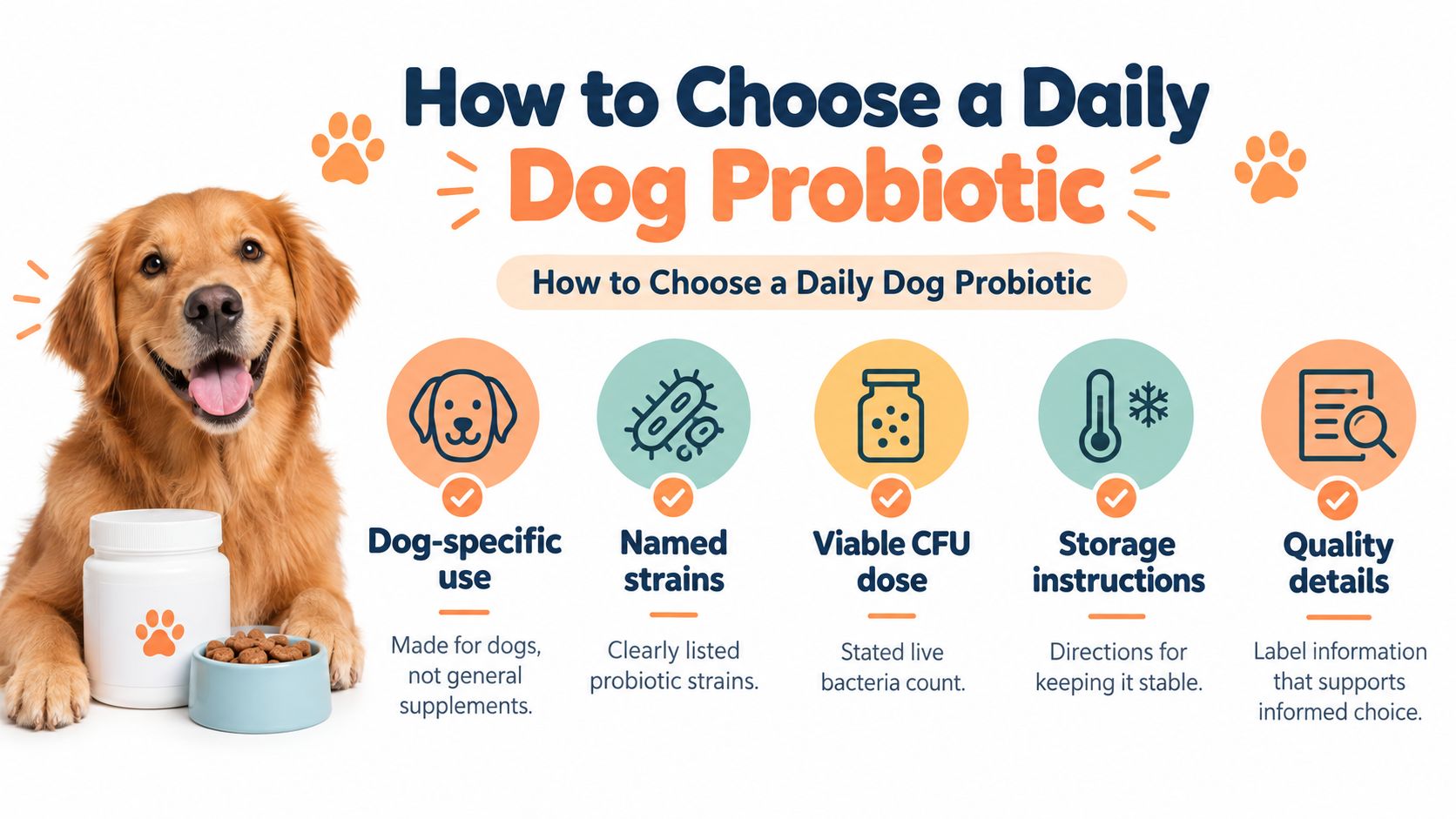
The checklist graphic below puts those label checks in one place for when you're comparing products side by side.
The Label Checklist That Actually Matters
- Dog-specific use: The product is made for dogs, with dosing and organisms chosen for them rather than borrowed from a human formula.
- Named strains: You can read exactly which organisms are in it. An unnamed blend can't be matched to any evidence.
- Stated viable CFU dose: The label tells you how many live organisms a serving delivers, not just that some are present.
- Storage instructions: Live microbes are perishable. A label that won't say how to store the product isn't taking viability seriously.
- A claim matched to your goal: The intended use should line up with the problem you named, not a generic wellness promise.
Cornell's veterinary guidance gives a broad daily range of 1 to 10 billion CFU and says daily long-term use may be appropriate for some dogs, while also emphasizing that product studies should show the organism is nonpathogenic and doesn't promote antibiotic resistance, as set out in Cornell Riney Canine Health Center guidance on probiotics. Notice how wide that range is. It's a reminder that "more CFU" isn't a quality score.
Why You Can't Copy Another Dog's Dose
Because trials differ so much in strain, dose, diet, and duration, copying the regimen that worked for your neighbor's dog isn't evidence based. It's anecdote with extra steps. Follow the label on the product you bought.
Then watch the dog, not the jar. A veterinary review of probiotics, prebiotics and synbiotics in practice supports introducing a product as labeled and monitoring stool consistency, appetite, vomiting, gas, and allergic signs, then reassessing if there's no meaningful improvement. If nothing changes, the answer is to stop or investigate, not to escalate the dose.
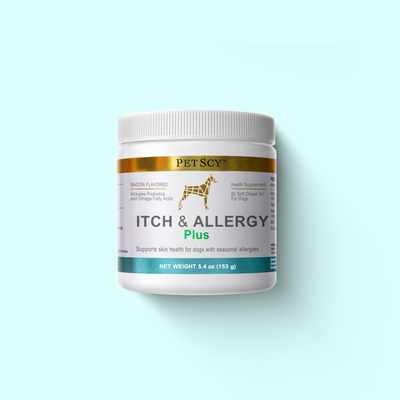
For a concrete example of how to apply the checklist, PetScy offers Probiotic Health Chews for digestive and immune support, and Itch & Allergy Plus Chews for cases where a probiotic blend is paired with skin-support ingredients aimed at seasonal itch. Both are veterinarian-formulated and made in the United States, and the company points to National Animal Supplement Council membership, third-party testing references, subscription options, free shipping, and a money-back guarantee. Treat those as quality and convenience details to weigh, not as a clinical trial result for those chews, because no such claim is being made here.
The decision is fit to your dog's goal. Brand loyalty shouldn't outrank a named strain and a monitoring plan.
How Long a Daily Probiotic Should Last
Owners ask "how long should I keep giving this" far less often than they ask whether to start, and that's exactly how a six week trial becomes a three year subscription. Duration deserves its own plan, decided before the first chew, not improvised when a refill ships.
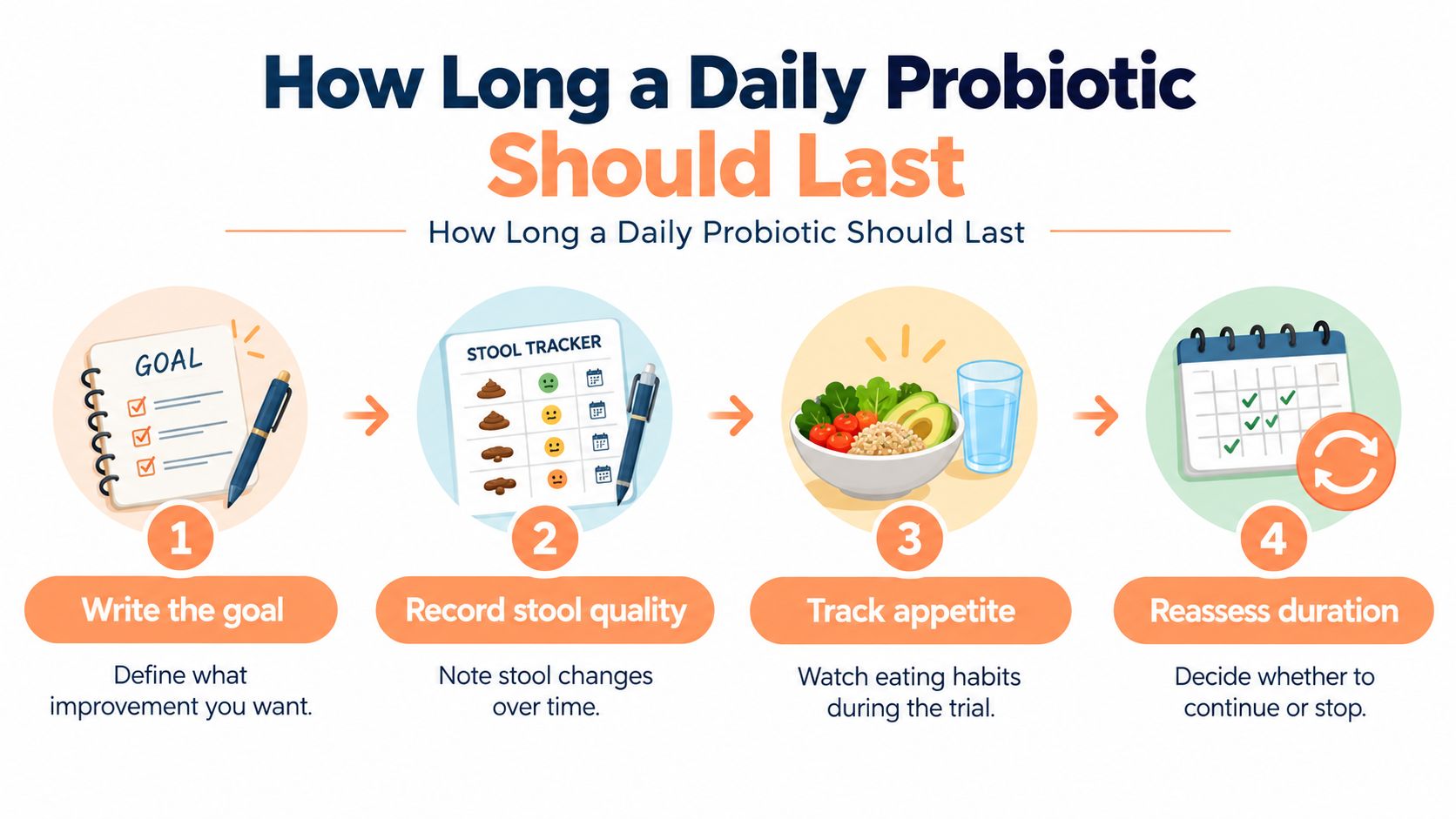
This four step flow shows the trial structure to set up before you begin.
Build a Four Part Trial
- Write the goal down. "Firmer stool during the boarding stay" beats "better gut health" because you can check it.
- Record your starting point. Note stool quality, appetite, gas, and any vomiting before you begin, so you're comparing against something real.
- Introduce the product as labeled. Don't improvise the dose, and don't change food, treats, and supplements all in the same week or you'll never know what did what.
- Reassess on an agreed date. Put it on the calendar with your veterinarian. A refill arriving isn't a reassessment.
If timing expectations are your main worry, how long probiotics take to work in dogs covers what to watch for as a trial unfolds.
The stop-or-continue test: If you can't point to a change you recorded, you don't have a reason to continue. "He seems fine" was true before you started.
What Duration Evidence Can and Cannot Tell You
Be prepared for an unsatisfying truth. Veterinary specialists note that relatively few canine studies exist, that study designs often prevent firm conclusions, and that the ideal treatment duration remains unknown. There is no validated universal course length hiding in the literature.
Even a 2025 pilot randomized trial illustrates the limits. It included only eight dogs with chronic kidney disease and intestinal disorders, found improved fecal consistency after 50 days, and its authors still explicitly called for larger studies and microbiome analysis. Eight dogs is a reason to keep researching, not a dosing schedule for your dog.
So use common sense boundaries. Short courses fit transient stress or a brief upset, where the trigger ends and so should the supplement. Chronic gastrointestinal disease is different. It needs veterinary reassessment, and stool appearance alone can't tell you whether the underlying disease is controlled.
Stop and call the clinic if there's no meaningful change by your check-in date, or sooner if diarrhea persists or blood, weight loss, lethargy, or vomiting appears. Probiotics complement diagnosis, diet, and medical care. They don't replace any of them.
Your Next Step After the Trial
Do one concrete thing this week. Sit down and write three lines about your dog. Line one is the goal, in observable terms. Line two is where things stand now, covering stool, appetite, weight trend, and energy. Line three lists anything relevant in the background, including antibiotics, upcoming travel or boarding, a planned food change, and any chronic diagnosis already on the chart.
Then take those three lines to your veterinarian and ask a specific question. Not "are probiotics good," but "does a dog-specific product with named strains make sense for this goal, and when should we check whether it's working?" That framing gets you a product decision and a date, which is the whole point.
If a Trial Gets the Green Light
Start at the label dose. Keep a simple log, nothing elaborate, just stool quality, appetite, and anything unusual, noted in your phone. Hold everything else steady while you do it. When the check-in date arrives, you have three honest options.
- Stop: Nothing changed, or the stressful event ended and stool stayed normal. Continuing buys you nothing.
- Continue: You recorded a real improvement tied to your goal, and your veterinarian agrees there's an ongoing reason.
- Investigate: Symptoms persist or return, which means the probiotic was never the missing piece and something else needs finding.
If you're comparing vet-formulated supplements while you decide, Probiotic Health Chews are the relevant daily digestive option, and Itch & Allergy Plus Chews fit better when seasonal itch is the main complaint alongside a probiotic blend. Pick based on the goal you wrote down, not on which jar has the louder label.
One last point about convenience. A subscription is useful when a product has earned its place, because you won't run out mid-trial. But the renewal should follow your reassessment, not replace it. If the check-in says stop, cancel or pause. Letting an auto-shipment make a medical decision for you is backwards.
And if your dog is immunocompromised, or you're seeing vomiting, blood, weight loss, lethargy, or diarrhea that won't quit, skip the trial entirely and book the exam first. A live-microbe product can wait. A diagnosis shouldn't.
If a monitored trial makes sense for your dog, PetScy offers veterinarian-formulated Probiotic Health Chews for digestive support and Itch & Allergy Plus Chews when seasonal itch is part of the picture, both made in the United States with subscription options and free shipping. Visit the store, check the strains and dosing against the goal you wrote down, and set your reassessment date before the first refill ever ships.